
Kim Hyunjung
Living Palaces The People Who Sustained Korea’s Royal Court


39,90 €
-
Art.Nr./ISBN: 9781565915404
-
Verlag: Hollym
-
Seitenzahl: 144
-
Einband: Softcover
-
Jahr: 2026
-
Sprache: English
-
Medientyp: Book
-
Autor: Kim Hyunjung
Derzeit nicht auf Lager. Lieferbar ab dem 3. August 2026
Produktinformationen "Living Palaces"
“The Lives and Stories of the Nameless People Behind the Splendor of the Palace”
A Hidden World Behind the Splendor
Behind the grand halls, elegant
rooftops, and royal magnificence of the palace lay another world-one
largely unknown. This book explores the palace as a place sustained by
countless invisible hands: organizing documents, preparing food, and
crafting garments. It reveals the roles of these individuals and the
intricate system they built and refined over generations.
The King’s Day and Those Who Moved It
The
king’s daily routine was more than a personal schedule-it symbolized
the order of the nation. From the moment he awoke, through study, court
assemblies, and rituals, every aspect of his day followed Confucian
principles. His daily life embodied the values and governing philosophy
of Joseon society. Following the king from dawn, this book presents a
vivid portrait of palace life while illuminating how court ladies,
eunuchs, and officials worked in coordination to sustain both the royal
household and the state.
A Refined System and Hidden Tensions
The
palaces of Joseon were not merely royal residences, but living systems
where politics, ritual, and daily life coexisted. From the king’s meals
and attire to the delivery of royal commands, everything was governed by
strict rules and procedures. Beneath the elegance lay constant tension
and responsibility, where even the smallest mistake was unacceptable,
and the palace operated on unwavering order.
The Stories of Those Hidden in History
Behind
the palace stood countless individuals-court ladies, eunuchs, royal
secretaries, cooks, and artisans-each playing a vital role in sustaining
the king’s life and the workings of the state. Their expertise and
dedication, from preparing meals and safeguarding the king’s health to
delivering commands and keeping records, kept the palace running.
Through this book, the lives of those often absent from official records
are brought vividly to life. Their devotion, sacrifice, and humanity
transform the palace into a living space rather than a mere structure.
A New Way to See the Palace
Following the king’s daily routine, this book shines a light on the people who brought the palace to life. Through the stories and presence of those who existed beyond its splendid architecture, it reveals how the palace functioned as a living entity. Readers will come to see that the palace is not simply a historic structure, but a world shaped and sustained by people.
About the Author
Kim Hyunjung graduated from Ewha Womans University with a degree in Korean Language and Literature and completed a master’s program in Korean language education at Sungkyunkwan University’s Graduate School of Education. She has worked as a broadcast writer, producing current-affairs and cultural programs centered on history, everyday life, and human stories, including KBS 1TV’s Documentary Insight – The Big Team and the TVING original documentary series Food Chronicle and Human Chronicle.
In her first book, Living Palaces, she draws on a narrative sensibility cultivated through her experience as a middle and high school Korean language teacher, as well as her work in publishing, writing, and magazine editing, to vividly portray the lives and roles of the people who sustained Korea’s royal palaces, offering a compelling glimpse into the richness of Korean royal culture.
| Sprache: | englisch |
|---|
15, Jongno 12-gil, Jongno-gu
03190 Seoul
Südkorea
Prinzenweg 10
93047 Regensburg
Deutschland
Anmelden

Ähnliche Titel

There may be countless idioms about beauty in languages around the world, but to actually define beauty and how it is expressed by an entire culture is a formidable task. Fortunately for readers, Korean Beauty: Visual Expressions of a Timeless Spirit approaches the subject with an engaging, deeply enriching account of what has long constituted core elements of Korean beauty, from the philosophical and spiritual currents that run through the concept all the way to the artistic practicality of how this is carried out on a daily basis. Uniquely Korean Expressions of Beauty With a mixture of personal stories by someone who has traveled extensively around the country and fascinating insights about an aesthetic heritage developed over thousands of years, long-time Korea commentator and author Robert Koehler takes readers on a memorable trip into a land of breathtaking elegance and refinement that has influenced generation after generation of Koreans and the way they express beauty. As is clearly evident to anyone familiar with the country and its people, this sense of beauty can be generally characterized in terms such as grace, simplicity, rustic charm, and respect for nature. Of course, this ethereal sense of beauty and its functional application to day-to-day living goes far deeper than those broadly defined descriptions. Beauty in Imperfection Today, visitors to Korea will be quick to point out the polished beauty of everyday objects that can be purchased at both souvenir stands and high-end galleries, including bowls and plates, chopsticks and spoons, glassware and ceramics, and jokja (hanging scrolls featuring artwork and/or calligraphy) and sansuhwa (landscape paintings). And yet look below the surface and you will notice a uniquely Korean “artless art,” an ability to make difficult designs appear easy to create and a tendency to value the perfectly imperfect. This is even apparent in the largest of artistic productions, including Korea’s royal edifices like Gyeongbokgung Palace, Buddhist sanctuaries such as Gaesimsa Temple, and the traditional Korean homes (hanok) and their accompanying courtyards (madang) of Bukchon Hanok Village. A Timeless Odyssey of Art and Beauty Embark on a magical journey through the UNESCO World Cultural Heritage Sites of Byeongsanseowon Confucian Academy and Changdeokgung Palace, marvel at age-old ramie weaving techniques in Hansan and the sublime works of Goryeo celadon from a thousand years ago, and indulge in Korea’s distinct palette of “five direction colors” through its obangsaek—no matter where you go within the country, Korea’s rich aesthetic is all around you at every step of the way. Something for EveryoneFrom the Buddhist and Taoist notion that there is great beauty in emptiness, to the extravagant visual appeal of modern hanbok and Korean accessories and boudoir crafts, to the fascinating method behind how Dansaekhwa monochrome paintings are created, Korea has practiced its own way of celebrating beauty for millennia. For those who have already started learning about Korea through its Hallyu-led movies, music, and television shows, Korean Beauty: Visual Expressions of a Timeless Spirit will only galvanize you to further your learning about the country and its profound, one-of-a-kind aesthetic. And for those just starting their odyssey down the road of Korean beauty, this book will inspire you to see more of the awe-inspiring splendor evident in this 5,000-year-old nation by experiencing Korea’s timeless spirit for yourself. About the Author Robert Koehler was born and raised in Long Island, New York, and graduated from Georgetown University’s School of Foreign Service in Washington, D.C. He came to Korea in 1997. From 2006 to 2018, he served as editor-in-chief of SEOUL, a monthly lifestyle and travel magazine. In 2009, he published the more than 400-page English-language guidebook SEOUL, and in 2010, he received the “Foreign Journalist Award for Contributions to Seoul Tourism” at the Seoul International Tourism Fair. He currently works as an English editor at the Korea JoongAng Daily. About the PhotographerLee Jongkeun graduated from Chung-Ang University’s Department of Photography and the graduate school of the same university. He runs a photo and video production company called GuruVisual Co., Ltd., and also teaches advertising photography at his alma mater. He has long been actively engaged in product, architecture, and food photography, and has worked on many familiar advertising campaigns as a photographer. Architecture books that capture his vision include Korea Style, Hanok: The Korean House, and Hanok Today.ContentsIntroduction • 9 1. Korean Aesthetics Standards of the past • 16 Harmony between humans and nature • 16 Rustic simplicity • 26 2. Different Notions of Korean and Western Beauty Realism vs. true spirit • 38 Realistic vs. idealized worlds • 42 Grandeur vs. harmony • 45 3. The Beauty of Emptiness Humanism • 61 Humor • 64 Preserving age-old aesthetic techniques • 69 More globalized tastes • 74 4. Korean Gyubang Crafts The aesthetic of the slow • 82 Making it look simple • 84 Useful but exquisite • 86 Embroidery arts • 94 A magnificent folding screen • 100 A lavish robe • 102 5. Traditional Korean Architecture Harmony with nature • 108 Tying it all together through the madang • 114 Rustic charm • 118 The borrowed landscape • 122 6. Hanbok An outfit steeped in history • 132 The beauty of modesty • 133 Generosity, emptiness, nature • 136 Color contrasts • 139 Fabrics of nature • 142 A modern touch • 145 7. The Visual Arts An idealized world: The Korean landscape painting • 148 Celadon: Beauty in greenish blue • 159 Porcelain (non) perfection: The moon jar • 162 Dansaekhwa: Korean minimalism meets modern art • 165 Korean handicrafts: Form equals function • 170 Folk art: Beauty for the masses • 179 8. Korean Accessories Norigae • 184 Beoseon • 190 Flower shoes • 194 Traditional Korean hats for men • 198 9. The Korean World of Color Obangsaek: The five colors of the cosmos • 208 Korean palaces: A sea of red • 210 Korea’s colorful cuisine • 214 Korean wedding attire • 217 The Korean flag: A nation of harmony • 218 Dancheong • 220 Epilogue • 226
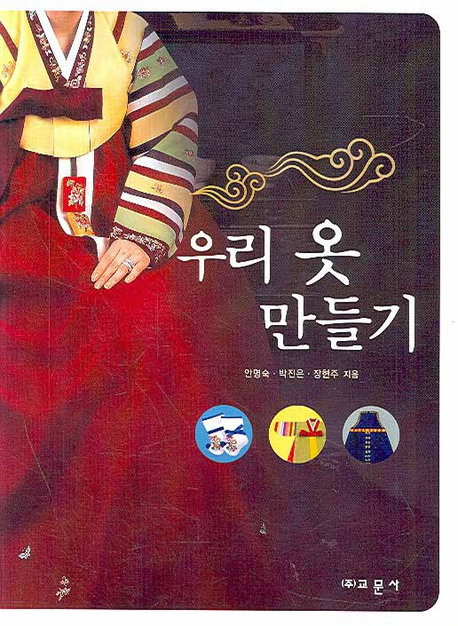
이 책이 속한 분야한복 만들기 입문서. 이 책은 한복의 특징과 한복 입는 법, 한복 구성의 기초와 여자와 남자, 아이 한복 만드는 법을 함께 담았다. 목차 제1장 한복의 미 한복의 특징 한복 디자인 우리 옷 입는 법 제2장 한복구성의 기초 필요 용구 치수재기 본뜨기 마름질 바느질 제3장 한복구성의 실제 여자 옷 만들기 치마 저고리 배자 당의 남자 옷 만들기 바지 저고리 조끼 마고자 두루마기 아동 옷 만들기 여아 옷 남아 옷 장식품 참고문헌 찾아보기
