
Bücher über FIlme, Regisseure, Kino

LIM is a director who signaled the emergence of a new kind of sensibility in Korean film. Through her debut film Three Friends, she brought the issue of 'individuality' and 'dailiness' into the embrace of Korean film. LIM's film gives attention to the life of the individual itself while simultaneously rousing awareness of reality. In this book you can trace LIM's changes and her footsteps in her search. Rather than analyzed forms of her works through a novel viewpoint or methodology, just follow how LIM has moved forward step-by-step through her search and experiments through a pathway that leads to LIM Soon-rye, who has built her own aesthetic world within contemporary Korean cinema.
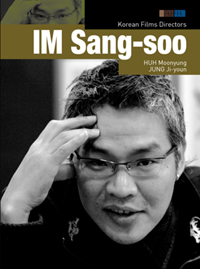
The stories that IM Sang-soo tries to tell deal with the lives of modern Koreans. He feels that the responsibility placed upon him as a storyteller is the history of "here and now" untold by older Korean directors of the same period. IM is practically the only director now making films that take a long look at the lives of contemporary Koreans without losing their historical sense. The major interest of this book is in examining the way in which his films observe the lives of modern Koreans. He does not view experimentation in style and form as important, but he realized early on that the stories he sought to tell often demanded unconventional form, and he has worked on polishing the formal beauty within his films to a dazzling degree.

List of LEE Myung-Se Films -M (2008) -Duelist Normal Edition, 'Hyeongsa' (2005) -Gagman (1988) LEE Myung-se marks himself as a rare director in the history of Korean films. In the Korean film industry, where the tradition of realism is deeply rooted and influence from Western-especially Hollywood-movies prevails, it is rare to find a director so absorbed in pursuing the fundamental question. 'What is the film?' Apart from a few directors digging into the subject these days, we can seldom find anyone who maintains this kind of attitude toward film. [...] Aspiring to be a craftsman rather than auteur. LEE can be called a sophiscated alchemist who can engrave images. His characteristic style, such as overlapping reality and dreams, antificially designing film sets like a stage play, and using cartoon-like images and unconventional music and sound shocked an industry dominated by conventional films. Unlike most 'New Wave' directors, who speculated more on storyline and style to talk about reality, LEE engrossed himself in finding out the identity of film as a cineartist. If 'Korean New Wave' produced 'films of reflections' in line with a changing society, LEE Myung-Se can be said to have produceed a real 'Cinema New Wave' pondering film itself, for the first time in Korean film history. -From the Preface

For almost 50 years, master director Im Kwon-taek has chronicled the tremendous events of Korea's twentieth century through the detached lens of the camera. This comprehensive volume of essays, interviews and biographical information from renowned film critic Chung Sung-ill delves deeply into the man behind the epics "Sopyonje," "The Taebaek Mountain," and "Chihwaseon." The publication of the Im Kwon-taek volume in 2007 could not be more timely, with the release of his 100th film, "Beyond Years," scheduled for April 2007. Im was born in 1934 in Jangseong, Jeolla Province, and lived through Japanese colonial occupation, the polarization of the political factions that led to the Korean War, decades of dictatorship, the dawn of democracy, and a rapidly changing society forgetting its past. This volume is a brilliant orchestration of the historical backdrop for Im's works with insight into the film director's psychology and personal experience. Contents Preface His Thoughts I: Eyewitness to History (1962-1992) His Thoughts II: Returning to His Roots (1993-Present) Interviews Biography Synopsis Filmography Endnotes References About the Author Index