Product information "Essential Korean 4-Character Idioms"
세계적인 한국어 학습 열풍과 함께 중급 이상 학습자들의 수가 늘어나면서 한국어의 일부로서 한자어 학습의 필요성이 절실해지고
있습니다. 이 책은 사자성어를 통해 한국어에서 한자어의 쓰임을 효과적으로 학습할 수 있는 교재로서, ‘국제 통용 한국어 표준
교육과정’에서 선정한 사자성어들과 국립국어원의 ‘한국어교수학습샘터’에서 제시하는 관용 표현으로서의 사자성어들 중 공통된 사자성어를
우선 선별하여 총 176개의 필수 사자성어를 다루고 있습니다. 이들 사자성어는 양태와 주제에 따라 과별로 4개씩 묶어
제시됨으로써, 학습자들은 유사한 상황에서 사용되는 사자성어들을 연관지어 배울 수 있습니다.
With the global surge
in Korean language learning and the increasing number of intermediate
and advanced learners, the importance of incorporating Sino-Korean words
into Korean language education has become crucial. Essential Korean
4-Character Idioms is an effective learning material for understanding
the usage of Sino-Korean words within the Korean language through
four-character idioms. It covers a total of 176 essential four-character
idioms, primarily selected from the common idioms listed by the
‘International Standard for Curriculum Korean Language’ and the ‘Center
for Teaching and Learning Korean’ of the National Institute of Korean
Language. These idioms are presented in groups of four per chapter,
categorized by modality and theme, allowing learners to associate
related expressions used in similar situations.
Contact the Publisher
Kong & Park, Inc.
85, Gwangnaru-ro 56-gil, Prime-center #3411, Gwangjin-gu 05116 Seoul Korea (Republic of)
Download Free Audio Files here
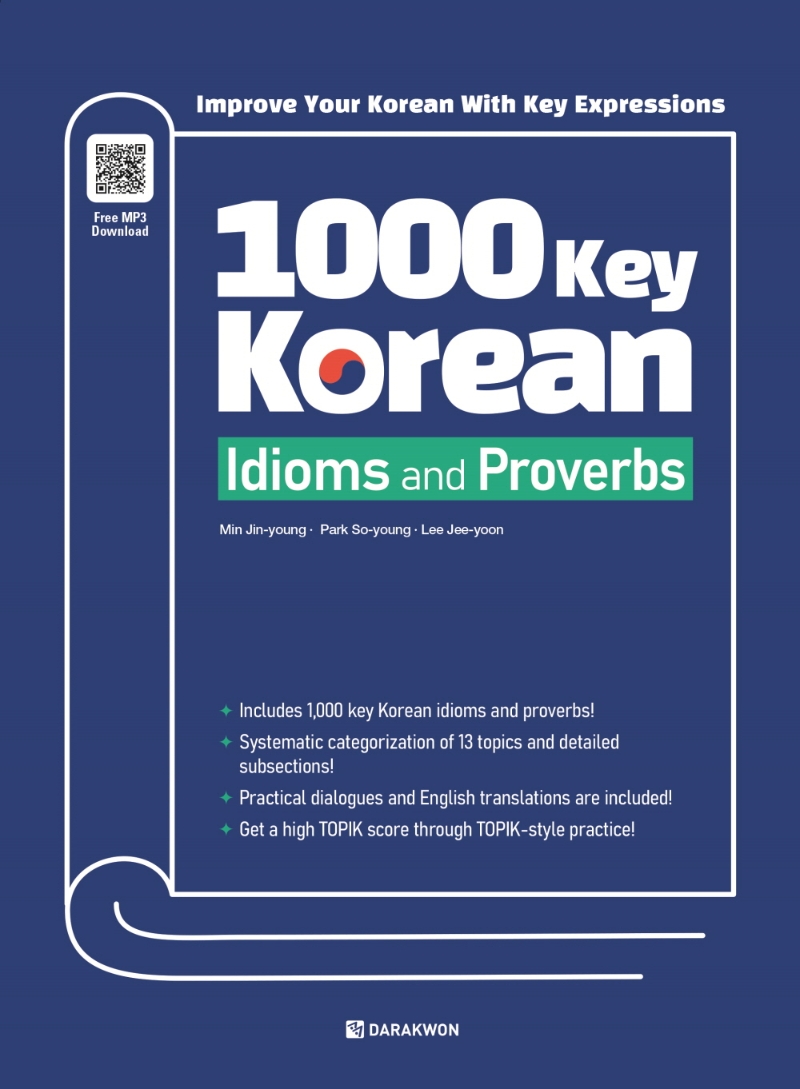
This book was designed to present Korean idioms and proverbs in the form of a dictionary to enable foreign students learning Korean to use these expressions in everyday conversation. Idioms and proverbs also appear as important expressions in TOPIK questions, and they are highly useful in everyday life. In this book, 1,000 idioms and proverbs that were selected according to frequency have been divided into 13 major themes and sub-topics to be studied. Vivid example sentences utilizing each expression are presented in a conversational format, and English translations and audio recordings are also provided to enhance students’ understanding. Using “Confirmation Questions” and “Idioms and Proverbs Seen in TOPIK Questions” in the appendix, students can check their level of understanding and identify how idioms and proverbs are mainly used in TOPIK reading questions, so this book can also be highly useful for preparing for the TOPIK exam. ▪ 1,000 carefully selected key Korean idioms and proverbs! This book contains a total of 1,000 entries that include expressions with high frequency of use and great educational effectiveness based on five major sources. Both Korean and English translations explaining the meaning of each entry are included, and synonyms, origins, and additional explanations are also provided to increase students’ understanding of each expression. ▪ Study by subject using 13 systematically categorized major themes and sub-topics! 1,000 expressions were categorized and sorted into 13 major themes, and the major themes were then divided into a total of 56 sub-topics so students could efficiently learn the expressions by grouping them by subject. Confirmation questions are provided in the appendix so students can check that they have mastered the expressions in each sub-topic and so they can review and self-evaluate. ▪ English translations and audio files of practical dialogues provided! Sample dialogues utilizing each expression are provided along with English translations so students can understand how each expression is used in actual conversations in context. In addition, audio files recorded by professional voice actors are provided through QR codes so students can master the correct pronunciation and intonation all at once. ▪ Obtain a high score on the TOPIK exam through TOPIK-style practice questions in the appendix! Using TOPIK-style practice questions in the appendix, students can check how the idioms and proverbs they have learned are presented in TOPIK reading questions. After studying the major themes, students can solve TOPIK-style questions to review the content they have learned while also completing adequate practice to achieve a high score on the TOPIK exam.
Contents
머리말 Preface 004 이 책의 구성 및 활용 How to use this book 006 목차 Table of Contents 010 1장 감정·정신 Emotions and Senses 1 감동·감탄 Being Moved and Admiration 014 2 걱정·고민 Worries and Troubles 018 3 고통 Pain 025 4 관심 Interest 031 5 불만·분노 Dissatisfaction and Anger 039 6 불안·초조 Anxiety and Nervousness 046 7 안도 Relief 053 8 욕심·실망 Greed and Disappointment 059 9 정신 상태 State of Mind 064 2장 소문·평판 Rumors and Reputation 1 간섭·참견 Interference and Meddling 070 2 긍정적 평판 Positive Reputation 078 3 부정적 평판 Negative Reputation 082 3장 태도 Attitude 1 겸손·거만 Humility and Arrogance 092 2 선택 Choices 096 3 의지 Will 103 4장 행동 Actions 1 대책 Countermeasures 112 2 반응 Reactions 117 3 방해 Obstructions 123 4 소극적 행동 Passive Behavior 127 5 적극적 행동 Active Behavior 133 5장 언어 Language 1 과장 Exaggeration 142 2 말버릇 Way of Speaking 148 3 행위 Action 154 6장 조언·훈계 Advice and Discipline 1 권고·충고 Recommendations and Advice 164 2 조롱 Ridicule 173 3 핀잔 Scolding 178 7장 일·생활 Work and Lifestyle 1 사회생활 Social Life 186 2 속성 Attributes 191 3 실행 Implementation 198 4 의식주 Life Necessities 206 5 종결 Termination 213 8장 경제 활동 Economic Activity 1 손익·소비 Profit & Loss and Consumption 220 2 형편 Circumstances 226 9장 관계 Relationships 1 갈등·대립 Conflict and Opposition 234 2 대우 Treatment 243 3 사교·친교 Social Interactions and Friendships 249 4 사랑·정 Love and Affection 256 5 소통·협력 Communication and Cooperation 262 10장 상황·상태 Situations and Conditions 1 결과 Results 268 2 곤란 Hardships 273 3 문제·문제 해결 Problems and Problem Solving 280 4 분위기·여건 Atmosphere and Conditions 284 5 시간·거리 Time and Distance 293 6 흥미 Excitement 297 11장 판단 Judgment 1 변별 Discrimination 304 2 신체 기관 Bodily Organs 311 3 외모·외형 Appearance and Looks 317 4 인지·인식 Perception and Awareness 323 12장 인생 Life 1 성공 Success 334 2 습관·경험 Habits and Experience 339 3 실패 Failure 350 4 운·기회 Luck and Opportunity 356 5 일생 Lifetime 365 13장 이치 Logic 1 인과 Cause and Effect 372 2 자연 Nature 378 3 진리 Truth 385 〈부록 Appendix〉 문화 이야기 Culture Story 394 확인해 봅시다 Let’s Check 407 TOPIK 속 관용 표현과 속담 Idioms and Proverbs in TOPIK 447 정답 Answer 460 색인 Index 465
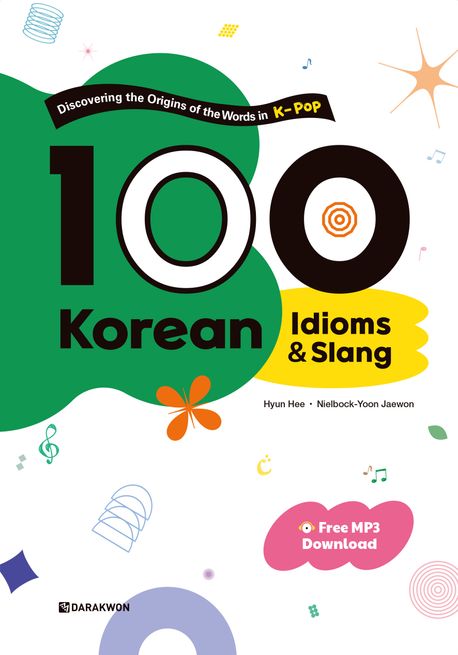
“When I listen to BTS’s song, the words ‘pumpkin seed’ are in there. Why on earth is that in there?” “In BLACKPINK’s song, when they miss someone, why are ‘intestines’ burning up?” Foreigners who like K-Pop and understand Korean lyrics to a certain degree might have seen the idioms and slang in the lyrics and tilted their head at these kinds of expressions. By presenting the idioms, four-character idioms, and slang hidden in K-Pop lyrics along with fun illustrations and example sentences, “100 Korean Idioms & Slang” was designed to help Korean-language learners at the intermediate level and above encounter and deeply understand Korean emotions and culture expressed in K-Pop lyrics, all while acquiring and having a command of various Korean expressions. Through simple quizzes and detailed explanations, this book allows readers to learn the origin and meaning of 50 idioms, 25 four-character idioms, and 25 slang words that appear in song lyrics, and helps them to understand K-Pop lyrics. Vivid descriptive examples and dialogues are presented for each expression, so you can practice and understand the context in which the expressions are used. Additionally, for each expression and example sentence, MP3 audio files of professional voice actors are provided via QR code, so you can check and follow along with the correct pronunciation and intonation. * Learn expressions that are actually used in K-Pop! Finds and explains the meaning of idiomatic expressions, four-character idioms, and slang words that are actually used in various K-Pop songs that are gaining popularity all around the world, so that foreign learners can grow more accustomed to Korean idiomatic expressions that can be difficult and unfamiliar. * You can infer the meaning of expressions through fun illustrations and quizzes to help you guess definitions! Idiomatic expressions aren’t frequently used with a literal meaning. With fun illustrations and simple quizzes, interest is maintained and you can do simple checks of your own knowledge, allowing learners to try to infer the meaning and usage of idiomatic expressions for themselves. * Through sound files, you can learn intonation and vivid nuance, and use expressions like a native speaker! Various idiomatic expressions and slang are used not just in K-Pop lyrics, but also in the daily lives of Korean people. Accordingly, by listening to and following along with sound files of professional voice actors for all expressions and example sentences, you can practice intonation and vivid nuance, and use expressions naturally like Koreans do in real-life conversations. * Check out idiomatic expressions found in a variety of K-Pop songs! Each expression introduces the K-Pop songs in which it is used, allowing learners to check out various songs in which an expression appears, aside from the songs they already know. If there’s a song you’re unfamiliar with, you can search for it and listen to it, and review while listening to the lyrics to hear the context in which the expression you learned is used.
Table of Contents
서문 Preface 4일러두기 How to Use This Book 6차례 Table of Contents 10Part 1 관용어 Idioms 12 1. 간에 기별도 안 가다 For the message to not even reach the liver 142. 고삐를 늦추다 To loosen the reins 163. 골로 가다 To go to the valley 184. 골탕 먹다 To eat bone broth soup 205 귀에 못이 박히다 To get a callus in your ear 226. 그림의 떡 Rice cake in a picture 247. 김칫국부터 마시다 To drink kimchi soup first 268. 깡통을 차다 To wear a can 289. 깨가 쏟아지다 To rain sesame seeds 3010. 낙인 찍다 To brand 3211. 눈 깜짝할 사이 In the blink of an eye 3412. 눈 하나 깜짝 안 하다 To not blink an eye 3613. 눈앞이 캄캄하다 For it to be dark in front of one’s eyes 3814. 눈에 밟히다 To have one’s eye stepped on 4015. 대박이 나다 For a large gourd to sprout 4216. 뒷구멍으로 호박씨를 까다 To shell pumpkin seeds with your behind 4417. 딴전을 부리다/피우다 To act like it’s a different shop 4618. 말짱 도루묵 All sandfish 4819. 머리에 맴돌다 To hover in one’s head 5020. 바가지를 긁다 To scratch the bowl 5221. 바람을 피우다 To act like the wind 5422. 발이 떨어지지 않다 For one’s feet to not come up off the ground 5623. 배가 아프다 For one’s stomach to hurt 5824. 배꼽을 잡다 To grab one’s belly button 6025. 배알이 꼴리다 For one’s guts to be twisted 6226. 백기를 들다 To raise a white flag 6427. 본전도 못 찾다 To be unable to even find the principal 6628. 비위를 맞추다 To adjust one’s stomach 6829. 산통을 깨다 To break the box of fortunes 7030. 새빨간 거짓말 A bright red lie 7231. 속이 타다 For one’s insides to burn 7432. 손꼽아 기다리다 To wait counting on one’s fingers 7633. 시치미를 떼다 To take a name tag off a falcon 7834. 애가 타다 For one’s intestines to burn 8035. 약이 오르다 For one to be nettled 8236. 어깨가 무겁다 For one’s shoulders to be heavy 8437. 오지랖이 넓다 For the front of one’s clothes to be wide 8638. 이를 악물다 To grit one’s teeth 8839. 족쇄를 채우다 To put shackles on 9040. 쥐도 새도 모르게 Without a mouse or a bird realizing 9241. 직성이 풀리다 For one’s star to be released 9442. 찬물을 끼얹다 To douse with cold water 9643. 총대를 메다 To carry the gunstock 9844. 탈을 쓰다 To wear a mask 10045. 통이 크다 For the size to be big 10246. 퇴짜를 놓다/맞다 To mark/to be marked with the character for “reject” 10447. 트집을 잡다 To grab at a hole 10648. 풀이 죽다 For the starch to give way 10849. 학을 떼다 To get rid of malaria 11050. 허리띠를 졸라매다 To tighten one’s belt 112Part 2 사자성어 Four-Character Idioms 11451. 경거망동 To behave frivolously and foolishly 11652. 고진감래 After all of the bitterness comes sweetness 11853. 금상첨화 Adding flowers on top of silk 12054. 기고만장 For one’s energy to rise to a height of 10,000 jang 12255. 노심초사 To be so concerned with something that one burns with worry 12456. 대기만성 For a large bowl to be completed late 12657. 배은망덕 To forget and betray the favor you received from someone 12858. 백발백중 To shoot 100 times and hit 100 times 13059. 백전백승 To fight 100 times and win 100 times 13260. 사필귀정 Everything will certainly return to the proper path 13461. 안하무인 Below one’s eyes, nobody exists 13662. 약육강식 The flesh of the weak becomes the food of the strong 13863. 오매불망 To be unable to forget while asleep or awake 14064. 우유부단 To be so soft that one can’t make a decision 14265. 유유자적 To live as one pleases, inleisure and relaxation 14466. 이심전심 To communicate from heart to heart 14667. 이열치열 To use heat to deal with heat 14868. 작심삼일 A firmly made up mind cannot last 3 days 15069. 절치부심 To gnash one’s teeth and for one’s mind to be troubled 15270. 조강지처 A wife who sared a meal of dregs of liquor and rice bran 15471. 천방지축 The direction of the heavens and the axis of the earth 15672. 천생연분 A relationship decided by the heavens 15873. 칠전팔기 To fall down seven times and get up eight times 16074. 함흥차사 A government official dispatched to Hamheung 16275. 호시탐탐 A tiger stare and glowers 164Part 3 유행어 Slang 16676. 극혐 Ultra hate / Ultra disgusting 16877. 깜놀 Shocked / Shook 17078. 꼰대 Kkondae / Boomer 17279. 꽃길만 걷자 Let’s only walk on paths of flowers / Everything is coming up roses 174 80. 노답 No answer / No solution 17681. 노잼 No fun / Not funny 17882. 눈누난나 Nunu nana 18083. 라떼는 말이야 A latte is... / Back in my day 18284. 멘붕 Mental collapse / Mental breakdown 18485. 무야호 Mu-yahoo 18686. 소확행 Small but certain happiness 18887. 솔까 Honestly 19088. 심쿵 Heart boom / Heart pounding 19289. 썸 타다 To feel “Some” / To be in a situationship 19490. 어그로 Aggro / Provoking / Trolling 19691. 열폭 Inferiority explosion 19892. 인싸 Insider / Social / Popular 20093. 입덕하다 To become a fan / To get hooked 20294. 지못미 Sorry I couldn’t protect you 20495. 쩔다 To be salted / To be awesome / To be very good or bad 20696. 최애 Most loved / Bias 20897. 취향 저격 Preference shot / My style 21098. 하드 캐리 Hard carry / To carry 21299. 흑역사 Dark history / Dark past 214100. 1도 모르다 To not know / To know nothing / To have no idea 216부록 Appendix 218퀴즈 정답 Quiz Answer 220의미와 용례 한국어 설명 Meaning & Origin in Korean 225K-Pop 색인 Index of K-Pop Songs 248100개 표현 목록 Alphabetical Index of 100 Expressions 260
『속담을 알면 한국어가 쉬워진다』는 한국인들이 일상에서 흔히 사용하는 200개의 속담을 이해하기 쉽게 정리한 책이다. 속담의 실제
의미는 물론이고, 비슷한 영어 표현과 어떤 점에서 비슷하고 혹은 같은지를 알 수 있도록 체계적인 단계의 연습 문제도 마련했다.
또한 한국인들의 일상 대화를 지문으로 구성해 한국인들이 어떤 상황에서 속담을 사용하는지 자연스럽게 익힐 수 있게 했다.책에 실린
대화문은 음성 파일로 들을 수 있고 무료로 다운로드 받을 수 있다. 『Essential Korean Proverbs』 is a
book that summarizes 200 proverbs commonly used by Koreans in their
daily lives in an easy-to-understand way. We have prepared a systematic
level of practice tasks so that you can learn the actual meaning of the
proverb as well as how similar to a corresponding English expression it
is. Moreover, by adding examples of daily conversations in Korean, you
can naturally learn in which situations Koreans use certain
proverbs.*Scan the QR codes in the book to use accompanying audio files.