Skip to main content Skip to search Skip to main navigation

Hyungwon Kang

Seonbi Country Korea Seeking Sagehood

Product information "Seonbi Country Korea"

About the Book 

The New Book Seonbi Country Korea: Seeking Sagehood Explores the Philosophical Foundation of Korean Culture Through Stunning Visual Storytelling 

“Discipline, Courage, Inclusion, Wisdom, and Honor—virtues long cultivated by Korea’s seonbi scholar-gentry—stand at the heart of the nation’s moral ethos, a living tradition remembered today as Seonbi Thought.” 

Award-winning photojournalist and author Hyungwon Kang announces the release of his most ambitious work to date: Seonbi Country Korea, Seeking Sagehood, a sweeping exploration of the uniquely Korean value system that shaped the nation’s moral and intellectual leadership for centuries. Through exquisite photography and deeply researched visual storytelling, Kang brings to life the enduring legacy of the seonbi—Korea’s scholar-gentry whose steadfast commitment to virtue forged the ethical backbone of Korean society. 

For more than five millennia, Korea’s seonbi leaders cultivated five universal pillars—Discipline, Courage, Inclusion, Wisdom, and Honor—values that guided statesmen, educators, philosophers, and warrior-intellectuals who shaped the country’s history. Kang’s work reveals how these same principles continue to influence Korea’s contemporary norms, institutions, civic culture, and collective identity. 

In this landmark volume, readers experience Kang’s finest visual storytelling. Each chapter illuminates one of the five seonbi virtues through powerful photography and compelling narrative. These stories highlight the scholar-officials and sage-leaders who lived out these ideals and steered pivotal moments—from governance and diplomacy to scholarship, ethics, and national defense. Kang also demonstrates how this philosophical heritage permeates modern Korean society, explaining its educational zeal, social cohesion, public-mindedness, and resilience. 

Seonbi Country Korea, Seeking Sagehood is both a cultural testament and an immersive visual journey—offering an unprecedented window into the traditions, values, and leadership philosophy that continue to define Korea today. 

What Is Seonbi? 

The seonbi were Confucian and Neo-Confucian scholar-gentry of Korea—from antiquity through the end of the Joseon Kingdom in 1910—who dedicated their lives to the pursuit of sagehood through disciplined moral practice. Far more than government functionaries, they were educators, advisors, and exemplars of ethical leadership, striving to embody the highest virtues in both thought and action. 

“What a great world it would be if humans could perfect society by training people to be dignified, mature egalitarians and free-thinking, responsible individuals,” Kang writes. “In Korean history, enlightened intellectuals pursued exactly this calling, seeking to become sages through a lifetime devoted to virtuous living.” 

Five Pillars of Seonbi Character 

In this book, journalist Hyungwon Kang presents a modern reinterpretation of Korea’s intellectual philosophy and spirit by outlining five core values and attitudes for cultivation. Centered on the five virtues of “Discipline (仁), Courage (義), Inclusion (禮), Wisdom (智), and Honor (信),” each chapter vividly documents one of the five seonbi values with stunning photos and insightful prose. 

1. Discipline (仁) and Training: Emphasizes perpetual discipline, love—the fundamental building block of all relationships—and lifelong learning with an aptitude of consistent ethical behavior based on honesty, integrity and respect for others, fostering a decent moral character. 

2. Courage (義) and Practice: The power of the unity of knowledge and action, meaning the intellectual courage to act on what one believes is right without fear of practical gains and losses or criticism. 

3. Inclusion (禮) and Respect: Beyond mere tolerance that endures others’ differences, it is the fundamental attitude of respecting and including others as dignified individuals, and working together with them. 

4. Wisdom (智) and Humility: True wisdom lies not in focusing on what one knows, but in knowing what one does not know; it is the virtue of humility in the pursuit of life-long learning. 

5. Honor (信) and Credibility: The value of good citizenship and trust that is built on the longevity of spoken words and actions, consistent with trustworthiness. 

From Ancient Wisdom to Modern Success 

Kang traces how seonbi character and principles have fueled Korea’s remarkable resilience and its recent rise as a global cultural force. He argues that Korea’s success is rooted in deep cultural reserves shaped by Seonbi Thought—reserves that enabled the nation to endure the traumas of Japanese colonization and the Korean War, and later to emerge as a powerhouse in arts, technology, and commerce. 

Seonbi Country Korea: Seeking Sagehood offers essential reading not only for those seeking deeper insight into Korean identity, but also for global readers who wish to understand the philosophical foundations behind the K-culture and its enduring appeal. 

All the photographs in Seonbi Country Korea were taken personally by photojournalist Hyungwon Kang, who documents Korea with the perspective of an outsider looking inward, yet rooted in Korean heritage. Each image carries its own story. Among the uniquely revealing photographs captured through this objective lens are: 

● A little-known 18th-century Hangeul memorial booklet titled “Seulpuda,” which illustrates the everyday use of Hangeul among seonbi scholars. 

● The carved-out name (pamyung) of a seonbi at Museongseowon, where political activity was strictly forbidden, extracted as punishment for violating the rules. 

● A royal talismanic sword (saingeom) once bestowed by Joseon kings upon their ministers, believed to possess protective spiritual power. 

● A photograph of a pair of cranes in flight, offering a visual analogy to Admiral Yi Sunsin’s famed Crane Wing Formation (hakikjin). 

● A storm-battered seowon—a scene of wind and rain—symbolizing the political bloodshed and purges of sahwa, when the seonbi class suffered persecution under rival factions. 

● A pair of crows stealing strands of horsehair, echoing an old saying that warns white egrets to beware of crows. 

Presented through the universal language of photography, this work of visual storytelling offers deep insight into Korean identity for readers in Korea, while also serving as an essential guide for global audiences seeking to understand the cultural foundations behind the worldwide appeal of K-culture.

About the Author 

Hyungwon Kang Hyungwon Kang is an award-winning photojournalist and columnist whose career has taken him across the globe. He has worked with Los Angeles Times, The Associated Press, and Thomson Reuters, documenting world events with a distinctive visual and narrative voice. 

As both a columnist and a photojournalist, Kang is a keen observer of culture, history, and human character, capturing stories through his camera lens and his writing with equal depth and clarity. 

Educated in the United States and fluent in multiple languages, Kang brings a rare, multilateral perspective—bridging Eastern philosophy with Western modes of communication. His work makes complex cultural ideas accessible to diverse global audiences, offering insights grounded in lived experience, rigorous observation, and a lifelong commitment to storytelling.

Contact the Publisher
Hollym Corp., Publishers
15, Jongno 12-gil, Jongno-gu
03190 Seoul
Korea (Republic of)
Responsible Person in the EU
Korean Book Services
Prinzenweg 10
93047 Regensburg
Germany

0 of 0 reviews

Average rating of 0 out of 5 stars

Leave a review!

Share your experiences with other customers.


Skip product gallery

Ähnliche Titel

New
Korean Beauty
There may be countless idioms about beauty in languages around the world, but to actually define beauty and how it is expressed by an entire culture is a formidable task. Fortunately for readers, Korean Beauty: Visual Expressions of a Timeless Spirit approaches the subject with an engaging, deeply enriching account of what has long constituted core elements of Korean beauty, from the philosophical and spiritual currents that run through the concept all the way to the artistic practicality of how this is carried out on a daily basis. Uniquely Korean Expressions of Beauty With a mixture of personal stories by someone who has traveled extensively around the country and fascinating insights about an aesthetic heritage developed over thousands of years, long-time Korea commentator and author Robert Koehler takes readers on a memorable trip into a land of breathtaking elegance and refinement that has influenced generation after generation of Koreans and the way they express beauty. As is clearly evident to anyone familiar with the country and its people, this sense of beauty can be generally characterized in terms such as grace, simplicity, rustic charm, and respect for nature. Of course, this ethereal sense of beauty and its functional application to day-to-day living goes far deeper than those broadly defined descriptions. Beauty in Imperfection Today, visitors to Korea will be quick to point out the polished beauty of everyday objects that can be purchased at both souvenir stands and high-end galleries, including bowls and plates, chopsticks and spoons, glassware and ceramics, and jokja (hanging scrolls featuring artwork and/or calligraphy) and sansuhwa (landscape paintings). And yet look below the surface and you will notice a uniquely Korean “artless art,” an ability to make difficult designs appear easy to create and a tendency to value the perfectly imperfect. This is even apparent in the largest of artistic productions, including Korea’s royal edifices like Gyeongbokgung Palace, Buddhist sanctuaries such as Gaesimsa Temple, and the traditional Korean homes (hanok) and their accompanying courtyards (madang) of Bukchon Hanok Village. A Timeless Odyssey of Art and Beauty Embark on a magical journey through the UNESCO World Cultural Heritage Sites of Byeongsanseowon Confucian Academy and Changdeokgung Palace, marvel at age-old ramie weaving techniques in Hansan and the sublime works of Goryeo celadon from a thousand years ago, and indulge in Korea’s distinct palette of “five direction colors” through its obangsaek—no matter where you go within the country, Korea’s rich aesthetic is all around you at every step of the way. Something for EveryoneFrom the Buddhist and Taoist notion that there is great beauty in emptiness, to the extravagant visual appeal of modern hanbok and Korean accessories and boudoir crafts, to the fascinating method behind how Dansaekhwa monochrome paintings are created, Korea has practiced its own way of celebrating beauty for millennia. For those who have already started learning about Korea through its Hallyu-led movies, music, and television shows, Korean Beauty: Visual Expressions of a Timeless Spirit will only galvanize you to further your learning about the country and its profound, one-of-a-kind aesthetic. And for those just starting their odyssey down the road of Korean beauty, this book will inspire you to see more of the awe-inspiring splendor evident in this 5,000-year-old nation by experiencing Korea’s timeless spirit for yourself. About the Author Robert Koehler was born and raised in Long Island, New York, and graduated from Georgetown University’s School of Foreign Service in Washington, D.C. He came to Korea in 1997. From 2006 to 2018, he served as editor-in-chief of SEOUL, a monthly lifestyle and travel magazine. In 2009, he published the more than 400-page English-language guidebook SEOUL, and in 2010, he received the “Foreign Journalist Award for Contributions to Seoul Tourism” at the Seoul International Tourism Fair. He currently works as an English editor at the Korea JoongAng Daily. About the PhotographerLee Jongkeun graduated from Chung-Ang University’s Department of Photography and the graduate school of the same university. He runs a photo and video production company called GuruVisual Co., Ltd., and also teaches advertising photography at his alma mater. He has long been actively engaged in product, architecture, and food photography, and has worked on many familiar advertising campaigns as a photographer. Architecture books that capture his vision include Korea Style, Hanok: The Korean House, and Hanok Today.ContentsIntroduction • 9 1. Korean Aesthetics Standards of the past • 16 Harmony between humans and nature • 16 Rustic simplicity • 26 2. Different Notions of Korean and Western Beauty Realism vs. true spirit • 38 Realistic vs. idealized worlds • 42 Grandeur vs. harmony • 45 3. The Beauty of Emptiness Humanism • 61 Humor • 64 Preserving age-old aesthetic techniques • 69 More globalized tastes • 74 4. Korean Gyubang Crafts The aesthetic of the slow • 82 Making it look simple • 84 Useful but exquisite • 86 Embroidery arts • 94 A magnificent folding screen • 100 A lavish robe • 102 5. Traditional Korean Architecture Harmony with nature • 108 Tying it all together through the madang • 114 Rustic charm • 118 The borrowed landscape • 122 6. Hanbok An outfit steeped in history • 132 The beauty of modesty • 133 Generosity, emptiness, nature • 136 Color contrasts • 139 Fabrics of nature • 142 A modern touch • 145 7. The Visual Arts An idealized world: The Korean landscape painting • 148 Celadon: Beauty in greenish blue • 159 Porcelain (non) perfection: The moon jar • 162 Dansaekhwa: Korean minimalism meets modern art • 165 Korean handicrafts: Form equals function • 170 Folk art: Beauty for the masses • 179 8. Korean Accessories Norigae • 184 Beoseon • 190 Flower shoes • 194 Traditional Korean hats for men • 198 9. The Korean World of Color Obangsaek: The five colors of the cosmos • 208 Korean palaces: A sea of red • 210 Korea’s colorful cuisine • 214 Korean wedding attire • 217 The Korean flag: A nation of harmony • 218 Dancheong • 220 Epilogue • 226

€43.90*
%
Inside Korea: Discovering the People and Culture (Bilingual)
Description: Korea is a nation with about five thousand years of history and rich cultural heritage. It is a country which realized stunning economic growth and democratic development in a very short span of time. In addition, Korea has recently been put on the proverbial global map, propelled by the Korean wave which hit the world, yet the country is still far from well-known across the world. What is Korea really like? In fact, it is not easy for both Koreans and non-Koreans to answer to this question. This query is where the idea of this book was first created.   This book is designed to increase understanding about Korea for people around the world and to present Korean society and culture in a thoughtful manner to foreigners who are not familiar with it. While a great deal of information about any country can be accessed through the internet, this book provides a broad range of information in an organized and systemized collection that is portable and easily accessible to many people. This bilingual publication is presented in both English and Korean in hopes that the information and appreciation of Korea can be shared with people around the world.   This book mainly consists of three parts. The first part (pp. 1-32) offers a brief introduction to Korea with reliable barometers in many aspects of Korean identity. The main part (pp. 33-446) of this book reveals Korea by eight categories: geography, history, politics, economy, society, culture, religion and religious culture, and scientific technology and industry. Two special commentaries on the North-South relations and East-West cultural differences are to help readers better understand Korea as a "divided country" with "Confucian culture." Finally, the last appendix section contains statistical information for the reader's convenient reference.  

€19.90* €29.90* (33.44% saved)
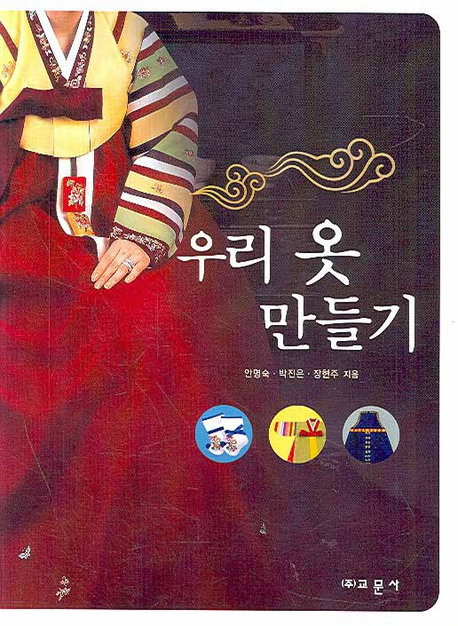
Uri ot mandeulgi - How to make Hanbok
이 책이 속한 분야 예술/대중문화 > 패션/의류 > 한복 한복 만들기 입문서. 이 책은 한복의 특징과 한복 입는 법, 한복 구성의 기초와 여자와 남자, 아이 한복 만드는 법을 함께 담았다. 목차 제1장 한복의 미 한복의 특징 한복 디자인 우리 옷 입는 법 제2장 한복구성의 기초 필요 용구 치수재기 본뜨기 마름질 바느질 제3장 한복구성의 실제 여자 옷 만들기 치마 저고리 배자 당의 남자 옷 만들기 바지 저고리 조끼 마고자 두루마기 아동 옷 만들기 여아 옷 남아 옷 장식품 참고문헌 찾아보기

€38.90*