
- Korean with K-Pop
- Han Kang
- Books in German
-
Books in English
-
LEARN KOREAN
- Active Korean
- Business Korean
- Darakwon
- Ewha Korean
- Get it Korean
- Grammar Books
- Hi Korean
- Hollym
- I Love Korean
- Integrated Korean
- Korean Made Easy
- Koryo University Fun
- Learn! Korean with BTS
- Master Korean
- Sejong Korean Textbooks
- Seoul University Korean
- SNU Korean+
- Sogang Korean
- Korean Language Calendar
- Talk to me in Korean
- TOPIK
- Yonsei University
- All Others
- Architecture
- Photobooks
- Nature & Wildlife
- History
- Society
- Children's Books
- Cooking
- Koreanisches Kino
- Arts and Culture
- K-Pop & Music
- Maps & Atlases
- Literature
- Handbooks & Reference
- North Korea
- Politics & Economy
- Travel Literature
- Religion & Philosophy
- Taekwondo
- Bilingual: Korean / English
-
LEARN KOREAN
- Books in Korean
- Dictionaries
- SPECIAL SALE
- Gifts for Readers & Writers
All Others
Topseller
Filter products
100 Korean Speech Patterns - Discovering Ways of Speaking in K-Drama “Why do Koreans start their sentences with ‘아니’ when they speak?” “I want to understand the lines spoken by my favorite actor, Park Bo-gum, in dramas.” As a follow-up to the 100 Korean Idioms & Slang for Korean language learners interested in K-culture, 100 Korean Speech Patterns has been published to help learners acquire truly authentic Korean through expressions featured in K-dramas. ▪ Learn “Real” Korean Speech Patterns through K-Drama Dialogue All the expressions and sentence patterns in this book originate from scenes in Korean dramas. While dramas are fictional stories, the speech styles and conversational patterns within them closely reflect real-life communication. 100 Korean Speech Patterns helps learners naturally acquire the tone, timing, and nuance of spoken Korean—elements that cannot be fully captured through grammar explanations alone—by learning expressions within their contextualized scenes. The moment you understand why a certain expression is used in a given situation, Korean will begin to sound much clearer. ▪ Step-by-Step Learning through Illustrations, Quizzes, Explanations, and Dialogue Practice Each unit opens with an illustration and dialogue inspired by a drama scene. Learners first observe the situation and then use a short quiz to infer the meaning and usage of the expression. The following explanation highlights the key points of the expression or pattern, while sample dialogues demonstrate its application in various contexts. In addition, professional voice recordings provided via QR codes enable learners to practice conversation with natural intonation and tone. ▪ 50 Expressions + 50 grammar Patterns: 100 Speech Habits for Immediate Use in Conversation 100 Korean Speech Patterns consists of two parts. Part 1 introduces 50 commonly used expressions such as “있잖아,” “솔직히,” “장난 아니야,” and “Don’t worry about it,” which Koreans frequently use in everyday speech. Part 2 covers 50 commonly used grammar patterns in real conversations, such as “-고 말았어,” “-더라고요,” and “-(으)ㄹ 수밖에 없어.” The appendices include quiz answers, dialogue translations, and explanations of meaning, as well as a K-Drama index and expression/pattern index, making the book highly useful for both review and reference.
Click here to download the audiofiles A 3-in-1 Korean beginner’s guide to mastering Hangeul, grammar, and conversation! ▪ Friendly and detailed explanations with practical learning tips—just like a one-on-one lesson Without the need to purchase separate books for learning Hangeul, grammar, and conversation, learners can achieve all three goals with just one book — My Korean Tutor for Ultimate Beginners. This book is therefore ideal for learners who need to prepare for basic Korean conversations but have limited study time, as well as for those who wish to acquire essential Korean speaking skills quickly and easily. ▪ Master basic Korean from Hangeul to everyday conversations in one book Every aspect—from Korean pronunciation and writing to conversational situations—is explained in English, enabling even beginners to confidently take on Korean conversation with detailed, teacher-like guidance that feels as if an instructor were right beside them. In addition, tips are provided in every unit for points that many learners tend to find confusing, allowing readers to pick up practical learning know-how along the way. ▪ Learn effectively and easily with Hangeul handwriting videos and short grammar video lectures In Parts 1 and 2, learners can access video content by scanning the provided QR codes. Part 1 offers “Hangeul Handwriting Videos,” which demonstrate the correct stroke order and pronunciation of Hangeul, allowing learners to watch the videos and practice writing the letters themselves. Part 2 provides short video lectures summarizing key grammar points in each unit, helping learners preview and review lessons or use the videos as supplementary online lectures to enhance their understanding of the material.
Speaking, listening, reading and writing, improving Korean is as a matter of course! Preparation for TOPIK is bonus! An integrated textbook that helps you improve Korean speaking, listening, reading and writing skills through functional activities in each language section Systematic and step-by-step Korean learning through activities by subject and unit studies Improving Korean language skills through learner-centered assignment activities in each unit. MP3 CD & Free Audio Download 비타민 한국어. 2 TOPIK 대비 겸용 한국어 교재 머리말 -----------------2 일러두기 ----------------4 목차 -------------------8 교재 구성표 -------------------10 등장 인물 -------------------14 1장 교통 1-1과 학교에서 명동까지 지하철로 얼마나 걸려요?------------------- 16 1-2과 인사동에 가려면 몇 번 버스를 타야 해요?------------------- 28 1-3과 육교를 지나서 우체국 앞에서 세워주세요------------------- 44 정리------------------- 58 문화------------------- 62 2장 생활 2-1과 점심에 무엇을 먹을까요?------------------- 64 2-2과 기숙사에서 요리해도 돼요?------------------- 76 2-3과 저는 수영을 할 수 있어요------------------- 88 정리------------------- 100 문화------------------- 110 3장 쇼핑 3-1과 옷을 사러 가요------------------- 112 3-2과 조금 작은 것 같아요------------------- 124 3-3과 더 컸으면 좋겠어요------------------- 136 정리------------------- 148 문화------------------- 158 4장 공공기관 4-1과 감기가 더 심해졌어요------------------- 160 4-2과 뉴욕으로 소포를 보내려고 하는데 얼마나 걸려요?------------------- 172 4-3과 10만 원만 환전할게요------------------- 184 정리------------------- 196 문화------------------- 206 5장 여가 5-1과 경주에 간 적이 있어요?------------------- 208 5-2과 음악을 들으면서 운동을 하고 있어요------------------- 220 5-3과 모르는 것이 있으면 언제든지 물어보세요------------------- 232 정리------------------- 244 문화------------------- 254 부록 정답 ----------------------------------------256 듣기 대본 -------------------------------------264 한국어 문법 설명 -------------------------------------270 색인 -------------------------------------274
Speaking, listening, reading and writing, improving Korean is as a matter of course! Preparation for TOPIK is bonus! An integrated textbook that helps you improve Korean speaking, listening, reading and writing skills through functional activities in each language section Systematic and step-by-step Korean learning through activities by subject and unit studies Improving Korean language skills through learner-centered assignment activities in each unit. MP3 CD & Free Audio Download Table of Contents 머리말 -----------------2 일러두기 ----------------4 목차 -------------------8 교재 구성표 -------------------10 등장 인물 -------------------14 1장 교통 1-1과 학교에서 명동까지 지하철로 얼마나 걸려요?------------------- 16 1-2과 인사동에 가려면 몇 번 버스를 타야 해요?------------------- 28 1-3과 육교를 지나서 우체국 앞에서 세워주세요------------------- 44 정리------------------- 58 문화------------------- 62 2장 생활 2-1과 점심에 무엇을 먹을까요?------------------- 64 2-2과 기숙사에서 요리해도 돼요?------------------- 76 2-3과 저는 수영을 할 수 있어요------------------- 88 정리------------------- 100 문화------------------- 110 3장 쇼핑 3-1과 옷을 사러 가요------------------- 112 3-2과 조금 작은 것 같아요------------------- 124 3-3과 더 컸으면 좋겠어요------------------- 136 정리------------------- 148 문화------------------- 158 4장 공공기관 4-1과 감기가 더 심해졌어요------------------- 160 4-2과 뉴욕으로 소포를 보내려고 하는데 얼마나 걸려요?------------------- 172 4-3과 10만 원만 환전할게요------------------- 184 정리------------------- 196 문화------------------- 206 5장 여가 5-1과 경주에 간 적이 있어요?------------------- 208 5-2과 음악을 들으면서 운동을 하고 있어요------------------- 220 5-3과 모르는 것이 있으면 언제든지 물어보세요------------------- 232 정리------------------- 244 문화------------------- 254 부록 정답 ----------------------------------------256 듣기 대본 -------------------------------------264 한국어 문법 설명 -------------------------------------270 색인 -------------------------------------274
An integrated textbook that helps you improve Korean speaking, listening, reading and writing skills through functional activities in each language section Systematic and step-by-step Korean learning through activities by subject and unit studies Improving Korean language skills through learner-centered assignment activities in each unit Free Audio Download 비타민 한국어. 2 TOPIK 대비 겸용 한국어 교재 머리말 -----------------2 일러두기 ----------------4 목차 -------------------8 교재 구성표 -------------------10 등장 인물 -------------------14 1장 교통 1-1과 학교에서 명동까지 지하철로 얼마나 걸려요?------------------- 16 1-2과 인사동에 가려면 몇 번 버스를 타야 해요?------------------- 28 1-3과 육교를 지나서 우체국 앞에서 세워주세요------------------- 44 정리------------------- 58 문화------------------- 62 2장 생활 2-1과 점심에 무엇을 먹을까요?------------------- 64 2-2과 기숙사에서 요리해도 돼요?------------------- 76 2-3과 저는 수영을 할 수 있어요------------------- 88 정리------------------- 100 문화------------------- 110 3장 쇼핑 3-1과 옷을 사러 가요------------------- 112 3-2과 조금 작은 것 같아요------------------- 124 3-3과 더 컸으면 좋겠어요------------------- 136 정리------------------- 148 문화------------------- 158 4장 공공기관 4-1과 감기가 더 심해졌어요------------------- 160 4-2과 뉴욕으로 소포를 보내려고 하는데 얼마나 걸려요?------------------- 172 4-3과 10만 원만 환전할게요------------------- 184 정리------------------- 196 문화------------------- 206 5장 여가 5-1과 경주에 간 적이 있어요?------------------- 208 5-2과 음악을 들으면서 운동을 하고 있어요------------------- 220 5-3과 모르는 것이 있으면 언제든지 물어보세요------------------- 232 정리------------------- 244 문화------------------- 254 부록 정답 ----------------------------------------256 듣기 대본 -------------------------------------264 한국어 문법 설명 -------------------------------------270 색인 -------------------------------------274
An integrated textbook that helps you improve Korean speaking, listening, reading and writing skills through functional activities in each language section Systematic and step-by-step Korean learning through activities by subject and unit studies Improving Korean language skills through learner-centered assignment activities in each unit Free Audio Download Contents 머리말 2 일러두기 4 목차 8 교재 구성표 10 등장 인물 14 1장 한글 11과 한글을 배워요 ① 16 12과 한글을 배워요 ② 28 13과 한글을 배워요 ③ 44 연습해 봅시다 58 문화 62 2장 소개 21과 만나서 반갑습니다 64 22과 저는 제인입니다 76 23과 이 사람은 누구예요? 88 정리 100 문화 110 3장 시간과 날짜 31과 몇 시에 일어나요? 112 32과 오늘이 몇 월 며칠이에요? 124 33과 주말에 무엇을 했어요? 136 정리 148 문화 158 4장 위치와 장소 41과 가방 안에 책과 공책이 있어요 160 42과 도서관에서 공부를 해요 172 43과 오른쪽으로 가세요 184 정리 196 문화 206 5장 미래 51과 산책을 할 거예요 208 52과 영화를 보려고 해요 220 53과 여행을 가고 싶어요 232 정리 244 문화 254 부록 정답 256 듣기 대본 264 한국어 문법 설명 267 색인 270
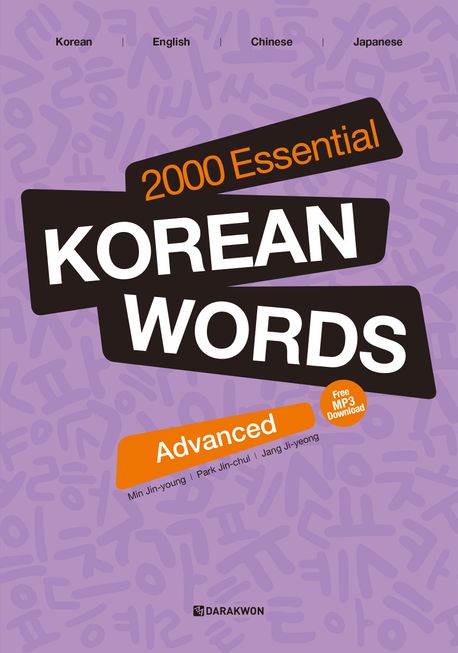
This book covers a total of approximately 2,000 words according to the following criteria. Selected the vocabulary words appeared more than 3 textbooks from the language institutes of ten universities on the advanced Korean level. • The words organized into fourteen topics. The provided example sentences are related to each topic focused on the example sentences used in textbooks and practical sentences frequently used in everyday life.• Useful word translations in English, Chinese, and Japanese!• The antonym, synonym, related word(s), and reference word(s) are provided in order to widen the students' vocabulary.• A review test similar with TOPIK with 'Let's Check'.• Through learning the Chinese characters, learners will be able to widen their vocabulary range.• Accurately recorded entry words and example sentences with MP3 files through QR codesTable of Contents머리말 Introduction 4이 책의 구성 및 활용 6How to use this book01 인간 1 People 1·人 1·人間 11 감정/감각 Emotions/Sensesㆍ感情/感觉ㆍ感情/感覚 16Let’s Check2 인상/성격 Impression/Personalityㆍ容貌/性格ㆍ印象/性格 29Let’s Check3 인지 행위 Cognitive Behaviorㆍ认知行为ㆍ認知行為 38Let’s Checkㆍ Korean through Chinese Characters 感 feelingㆍ感觉ㆍ感 4702 인간 2 People 2·人类 2·人間 21 신체/외양 Physical/Outward Appearanceㆍ身体/外表ㆍ身体/外見 50Let’s Check2 태도 Attitudeㆍ态度ㆍ態度 57Let’s Check3 행동/행위 Action/Behaviorㆍ行动/行为ㆍ行動/行為 69Let’s Checkㆍ Korean through Chinese Characters 變 to changeㆍ变ㆍ変 7803 삶 Life·生命·人生1 경조사 Family Eventㆍ喜事/丧事ㆍ慶事/弔事 80Let’s Check2 언어 행위 Speech Actㆍ语言行为ㆍ言語行為 86Let’s Check3 여가 생활 Leisure Lifeㆍ休闲生活ㆍ余暇生活 95Let’s Check4 인간관계 Human Relationsㆍ人际关系ㆍ人間関係 103Let’s Check5 일상 행위 Daily Behaviorㆍ日常行为ㆍ日常行為 113Let’s Checkㆍ Korean through Chinese Characters 相 each otherㆍ相ㆍ相 12104 의식주 The Necessities of Life·衣食住·衣食住1 식생활 Dietary Lifeㆍ饮食ㆍ食生活 124Let’s Check2 의생활 Clothing Lifeㆍ衣着ㆍ衣生活 133Let’s Check3 주생활 Housing Lifeㆍ居住ㆍ住生活 141Let’s Checkㆍ Korean through Chinese Characters 力 powerㆍ力量ㆍ力 14805 건강 Health·健康·健康1 건강 상태 Health Conditionㆍ健康状态ㆍ健康状態 150Let’s Check2 병/증상 Illness/Symptomㆍ疾病/症状ㆍ病気/症状 158Let’s Check3 치료 Treatmentㆍ治疗ㆍ治療 168Let’s Checkㆍ Korean through Chinese Characters 過 to be excessiveㆍ过分ㆍ過 17406 교육 Education·教育·教育1 교육 행정 Educational Administrationㆍ教育行政ㆍ教育行政 176Let’s Check2 적성/진로 Aptitude/Course in Lifeㆍ性向/出路ㆍ適性/進路 184Let’s Check3 철학/윤리 Philosophy/Ethicsㆍ哲学/伦理ㆍ哲学/倫理 192Let’s Check4 학문 용어 Academic Termㆍ学问用语ㆍ学問用語 199Let’s Check5 학문 행위 Academic Behaviorㆍ学问行为ㆍ学問行為 205Let’s Checkㆍ Korean through Chinese Characters 學 to learnㆍ学习ㆍ学 21607 사회생활 Social Life·社会生活·社会生活1 문제/해결 Problem/Solutionㆍ问题/解决ㆍ問題/解決 218Let’s Check2 사회 현상 Social Phenomenonㆍ社会现象ㆍ社会現象 229Let’s Check3 성공/실패 Success/Failureㆍ成功/失败ㆍ成功/失敗 238Let’s Check4 직장/직장 생활 Work/Life at Workㆍ职场/职场生活ㆍ職場/職場生活 249Let’s Checkㆍ Korean through Chinese Characters 成 to makeㆍ成就ㆍ成 25608 경제/경영 Economics/Business Administration·经济/经营·経済/経営1 경영 전략 Business Strategyㆍ经营策略ㆍ経営戦略 258Let’s Check2 경제 현상 Economic Phenomenonㆍ经济现象ㆍ経済現象 267Let’s Check3 경제 활동 Economic Activityㆍ经济活动ㆍ経済活動 275Let’s Check4 기업 경영 Business Managementㆍ企业经营ㆍ企業経営 282Let’s Check5 재무/금융 Finance/Bankingㆍ财务/金融ㆍ財務/金融 291Let’s Checkㆍ Korean through Chinese Characters 急 to be urgentㆍ急ㆍ急 29809 국가 Country·國家·国家1 법/질서 Law/Orderㆍ法律/秩序ㆍ法/秩序 300Let’s Check2 정치 Politicsㆍ政治ㆍ政治 310Let’s Check3 행정/사회 복지 Administration/Social Welfareㆍ行政/社会福利ㆍ行政/社会福祉 318Let’s Checkㆍ Korean through Chinese Characters 主 ownerㆍ主人ㆍ主 32510 문화/역사 Culture/History·文化/历史·文化/歴史1 대중문화 Popular Cultureㆍ大众文化ㆍ大衆文化 328Let’s Check2 역사 Historyㆍ历史ㆍ歴史 341Let’s Check3 전통문화 Traditional Cultureㆍ传统文化ㆍ伝統文化 349Let’s Checkㆍ Korean through Chinese Characters 意 meaningㆍ意思ㆍ意 35611 예술/스포츠 Arts/Sports·艺术/运动·芸術/スポーツ1 건축 Architectureㆍ建筑ㆍ建築 358Let’s Check2 문학 Literatureㆍ文学ㆍ文学 367Let’s Check3 스포츠 Sportsㆍ运动ㆍスポーツ 378Let’s Check4 예술 Artㆍ艺术ㆍ芸術 391Let’s Checkㆍ Korean through Chinese Characters 作 to make, to buildㆍ做,制造ㆍ作 40212 자연/환경 Nature/Environment·自然/环境·自然/環境1 기상/기후 Weather Condition/Climateㆍ气象/气候ㆍ気象/気候 404Let’s Check2 생태 Ecologyㆍ生态ㆍ生態 410Let’s Check3 자연 현상 Natural Phenomenonㆍ自然现象ㆍ自然現象 416Let’s Check4 재난/재해 Human Disaster/Natural Disasterㆍ灾难/灾害ㆍ災難/災害 424Let’s Check5 지형/지역 Topography/Regionㆍ地形/地域ㆍ地形/地域 433Let’s Checkㆍ Korean through Chinese Characters 物 itemㆍ物件ㆍ物 44213 과학/기술 Science/Technology·科学/技术·科学/技術1 교통/운송 Traffic/Transportationㆍ交通/运输ㆍ交通/運送 444Let’s Check2 정보/기술 Information/Technologyㆍ信息/技术ㆍ情報/技術 453Let’s Check3 통신/매체 Communication/Mediaㆍ通信/媒体ㆍ通信/メディア 465Let’s Checkㆍ Korean through Chinese Characters 度 lawㆍ法度ㆍ度 47414 성질 Properties·性质·性質1 속도/수량/크기 Speed/Quantity/Sizeㆍ速度/数量/大小ㆍ速度/数量/大きさ 476Let’s Check2 시간/시기 Time/Timingㆍ时间/时机ㆍ時間/時期 482Let’s Check3 의성어/의태어 Onomatopoeia/Mimetic Wordsㆍ拟声语/拟态语ㆍ擬音語/擬態語 490Let’s Check4 정도 Extentㆍ程度ㆍ程度 499Let’s Checkㆍ Korean through Chinese Characters 化 to becomeㆍ化ㆍ化 509부록 Appendix·附录·付録반의어/유의어, 접두사/접미사, 의존 명사 목록Antonyms/Synonyms, Prefixes/Suffixes, Bound Nouns 512ㆍ 유의어/반의어 Synonymsㆍ近义词ㆍ類義語 / Antonymsㆍ反义词ㆍ反対語 512ㆍ 접두사/접미사 Prefixesㆍ前缀ㆍ接頭辞 / Suffixesㆍ后缀ㆍ接尾辞 522ㆍ 의존 명사 Passive Verbsㆍ被动词ㆍ受身動詞 / Causative Verbsㆍ使动词ㆍ使役動詞 524정답 Answers 527색인 Index 532
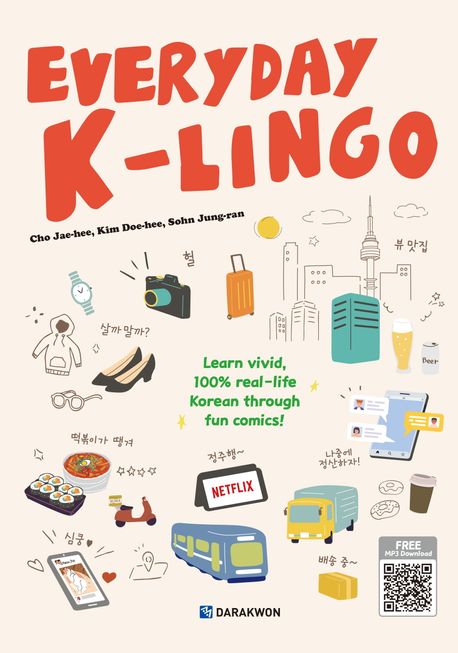
“우리 N빵하자!” “진실의 미간이 나오네!” How well do you know these kinds of expressions that Korean people naturally and frequently use? Even if you are diligently studying Korean, when you see Korean subtitles on YouTube or read Korean comments on Instagram, it’s easy to feel like you are missing something. As our daily lives have changed since the advent of smart devices, frequently used words and phrases have also changed. “Everyday K-Lingo” reflects these changes, selecting the theme of “new daily life” using smartphones, social media, online shopping, content streaming platforms, delivery apps, KakaoTalk, etc. and including vocabulary and expressions that are frequently used in that daily life. Download Sample Pages However, just because one knows a lot of words doesn’t mean that one can express them easily. For example, if you want to say, “I left a comment on my favorite celebrity’s Instagram,” you need to know the vocabulary word for “comment” (“댓글) as well as the expression “to leave a comment” (“댓글을 달다”), and then you need to know how to connect “Instagram” and “to leave a comment” with the particle “에.” In this way, you must remember chunks of meaning rather than individual vocabulary units so you can quickly speak in Korean about a situation or action that comes to mind. To this end, “Everyday K-Lingo” presents vocabulary words in meaningful groups rather than as individual words. In addition, the book uses vivid Korean expressions to construct dialogue in a variety of situations, enabling students to learn how to use expressions in specific situations. It also includes rich Korean expressions such as “배 터질 것 같아 (I feel like my stomach is going to explode)” as well as non-standard words, buzzwords, and new words such as “찐맛집 (a truly delicious restaurant).” You will be able to naturally improve your Korean skills by reading interesting dialogues presented in 4-panel cartoons as easily as reading a webtoon, as well as by listening to audio files provided through QR codes. * Learn real Korean that Koreans use in their daily lives! The Korean language that Koreans actually use in YouTube subtitles, Instagram comments, and KakaoTalk conversations is usually difficult to learn from books. In addition, because there are many abbreviations, non-standard words, buzzwords, and new words, it’s often difficult to understand them unless you learn how to use them in certain situations. “Everyday K-Lingo” covers a variety of vocabulary words and expressions that Koreans frequently use in daily life, helping you learn real Korean. * Learn chunks of meaning so you can connect them in conversation! Just because you know a lot of vocabulary words doesn’t mean that you can easily express what you want to say. This is because it is difficult to lead a conversation if you do not know which vocabulary words are used together and which particles you must use to connect them. To this end, “Everyday K-Lingo” presents vocabulary in meaningful groups rather than as individual words. By recalling the chunks of meaning that you’ve memorized according to a specific situation or action, Korean conversation will be able to flow smoothly from your mouth. * Naturally learn Korean expressions in specific situations through 4-panel comics! By expressing specific situations from daily life through cartoons, this book makes it possible to learn Korean expressions in a fun and natural way. If you read it casually as if you were reading a webtoon and use the QR codes to listen to lively audio clips recorded by professional voice actors, you will be able to effectively learn daily conversation situations of Koreans. Table of Contents 서문 Preface 4이 책의 활용법 How to Use This Book 8목차 Table of Contents 12주요 등장인물 Main Characters 151 핸드폰을 새로 샀다 I Bought a New Cell Phone! 17 (1) New Cell Phone 18(2) Using a Cell Phone 24(3) Using an App 30(4) Cell Phone Problems 362 나도 SNS 한번 해 볼까? Should I Try Using Social Media Too? 47(1) Starting to Use Instagram 48(2) Instagram Posts 54(3) Using Instagram 60(4) Using YouTube 663 인터넷만 보면 다 사고 싶어 I Want to Buy Everything I See on the Internet 77(1) Online Shopping 78(2) Purchasing 84(3) Making an Inquiry 90(4) Issues and Returning 964 오늘은 하루 종일 넷플릭스 Today, I’m Watching Netflix All Day Long 107(1) Selecting Content 108(2) Watching Content 114(3) Evaluating Content 120(4) Canceling and Reasons 1265 저녁에 뭐 시켜 먹지? What Should We Order for Dinner? 137(1) Using the Delivery App 138(2) Confirming and Serving Delivery Food 144(3) Eating Food 150(4) Leaving Reviews 1566 우리 만날래? Want to Meet Up? 167(1) Deciding on a Place via KakaoTalk 168(2) Reserving and Notifying 174(3) At a Restaurant 180(4) Paying and Settling up 1867 행복해지고 싶다면 떠나라 If You Want to Be Happier, Leave 197(1) Before Reaching the Destination 198(2) At the Accommodation 204(3) At a Must-Eat Place 210(4) Taking and Sharing Photos 216Appendix 227Korean Translation 228Index 243
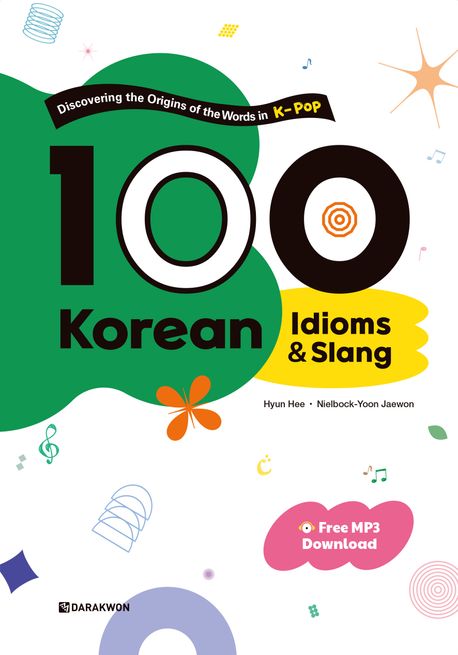
“When I listen to BTS’s song, the words ‘pumpkin seed’ are in there. Why on earth is that in there?” “In BLACKPINK’s song, when they miss someone, why are ‘intestines’ burning up?” Foreigners who like K-Pop and understand Korean lyrics to a certain degree might have seen the idioms and slang in the lyrics and tilted their head at these kinds of expressions. By presenting the idioms, four-character idioms, and slang hidden in K-Pop lyrics along with fun illustrations and example sentences, “100 Korean Idioms & Slang” was designed to help Korean-language learners at the intermediate level and above encounter and deeply understand Korean emotions and culture expressed in K-Pop lyrics, all while acquiring and having a command of various Korean expressions. Through simple quizzes and detailed explanations, this book allows readers to learn the origin and meaning of 50 idioms, 25 four-character idioms, and 25 slang words that appear in song lyrics, and helps them to understand K-Pop lyrics. Vivid descriptive examples and dialogues are presented for each expression, so you can practice and understand the context in which the expressions are used. Additionally, for each expression and example sentence, MP3 audio files of professional voice actors are provided via QR code, so you can check and follow along with the correct pronunciation and intonation. * Learn expressions that are actually used in K-Pop! Finds and explains the meaning of idiomatic expressions, four-character idioms, and slang words that are actually used in various K-Pop songs that are gaining popularity all around the world, so that foreign learners can grow more accustomed to Korean idiomatic expressions that can be difficult and unfamiliar. * You can infer the meaning of expressions through fun illustrations and quizzes to help you guess definitions! Idiomatic expressions aren’t frequently used with a literal meaning. With fun illustrations and simple quizzes, interest is maintained and you can do simple checks of your own knowledge, allowing learners to try to infer the meaning and usage of idiomatic expressions for themselves. * Through sound files, you can learn intonation and vivid nuance, and use expressions like a native speaker! Various idiomatic expressions and slang are used not just in K-Pop lyrics, but also in the daily lives of Korean people. Accordingly, by listening to and following along with sound files of professional voice actors for all expressions and example sentences, you can practice intonation and vivid nuance, and use expressions naturally like Koreans do in real-life conversations. * Check out idiomatic expressions found in a variety of K-Pop songs! Each expression introduces the K-Pop songs in which it is used, allowing learners to check out various songs in which an expression appears, aside from the songs they already know. If there’s a song you’re unfamiliar with, you can search for it and listen to it, and review while listening to the lyrics to hear the context in which the expression you learned is used. Table of Contents 서문 Preface 4일러두기 How to Use This Book 6차례 Table of Contents 10Part 1 관용어 Idioms 12 1. 간에 기별도 안 가다 For the message to not even reach the liver 142. 고삐를 늦추다 To loosen the reins 163. 골로 가다 To go to the valley 184. 골탕 먹다 To eat bone broth soup 205 귀에 못이 박히다 To get a callus in your ear 226. 그림의 떡 Rice cake in a picture 247. 김칫국부터 마시다 To drink kimchi soup first 268. 깡통을 차다 To wear a can 289. 깨가 쏟아지다 To rain sesame seeds 3010. 낙인 찍다 To brand 3211. 눈 깜짝할 사이 In the blink of an eye 3412. 눈 하나 깜짝 안 하다 To not blink an eye 3613. 눈앞이 캄캄하다 For it to be dark in front of one’s eyes 3814. 눈에 밟히다 To have one’s eye stepped on 4015. 대박이 나다 For a large gourd to sprout 4216. 뒷구멍으로 호박씨를 까다 To shell pumpkin seeds with your behind 4417. 딴전을 부리다/피우다 To act like it’s a different shop 4618. 말짱 도루묵 All sandfish 4819. 머리에 맴돌다 To hover in one’s head 5020. 바가지를 긁다 To scratch the bowl 5221. 바람을 피우다 To act like the wind 5422. 발이 떨어지지 않다 For one’s feet to not come up off the ground 5623. 배가 아프다 For one’s stomach to hurt 5824. 배꼽을 잡다 To grab one’s belly button 6025. 배알이 꼴리다 For one’s guts to be twisted 6226. 백기를 들다 To raise a white flag 6427. 본전도 못 찾다 To be unable to even find the principal 6628. 비위를 맞추다 To adjust one’s stomach 6829. 산통을 깨다 To break the box of fortunes 7030. 새빨간 거짓말 A bright red lie 7231. 속이 타다 For one’s insides to burn 7432. 손꼽아 기다리다 To wait counting on one’s fingers 7633. 시치미를 떼다 To take a name tag off a falcon 7834. 애가 타다 For one’s intestines to burn 8035. 약이 오르다 For one to be nettled 8236. 어깨가 무겁다 For one’s shoulders to be heavy 8437. 오지랖이 넓다 For the front of one’s clothes to be wide 8638. 이를 악물다 To grit one’s teeth 8839. 족쇄를 채우다 To put shackles on 9040. 쥐도 새도 모르게 Without a mouse or a bird realizing 9241. 직성이 풀리다 For one’s star to be released 9442. 찬물을 끼얹다 To douse with cold water 9643. 총대를 메다 To carry the gunstock 9844. 탈을 쓰다 To wear a mask 10045. 통이 크다 For the size to be big 10246. 퇴짜를 놓다/맞다 To mark/to be marked with the character for “reject” 10447. 트집을 잡다 To grab at a hole 10648. 풀이 죽다 For the starch to give way 10849. 학을 떼다 To get rid of malaria 11050. 허리띠를 졸라매다 To tighten one’s belt 112Part 2 사자성어 Four-Character Idioms 11451. 경거망동 To behave frivolously and foolishly 11652. 고진감래 After all of the bitterness comes sweetness 11853. 금상첨화 Adding flowers on top of silk 12054. 기고만장 For one’s energy to rise to a height of 10,000 jang 12255. 노심초사 To be so concerned with something that one burns with worry 12456. 대기만성 For a large bowl to be completed late 12657. 배은망덕 To forget and betray the favor you received from someone 12858. 백발백중 To shoot 100 times and hit 100 times 13059. 백전백승 To fight 100 times and win 100 times 13260. 사필귀정 Everything will certainly return to the proper path 13461. 안하무인 Below one’s eyes, nobody exists 13662. 약육강식 The flesh of the weak becomes the food of the strong 13863. 오매불망 To be unable to forget while asleep or awake 14064. 우유부단 To be so soft that one can’t make a decision 14265. 유유자적 To live as one pleases, inleisure and relaxation 14466. 이심전심 To communicate from heart to heart 14667. 이열치열 To use heat to deal with heat 14868. 작심삼일 A firmly made up mind cannot last 3 days 15069. 절치부심 To gnash one’s teeth and for one’s mind to be troubled 15270. 조강지처 A wife who sared a meal of dregs of liquor and rice bran 15471. 천방지축 The direction of the heavens and the axis of the earth 15672. 천생연분 A relationship decided by the heavens 15873. 칠전팔기 To fall down seven times and get up eight times 16074. 함흥차사 A government official dispatched to Hamheung 16275. 호시탐탐 A tiger stare and glowers 164Part 3 유행어 Slang 16676. 극혐 Ultra hate / Ultra disgusting 16877. 깜놀 Shocked / Shook 17078. 꼰대 Kkondae / Boomer 17279. 꽃길만 걷자 Let’s only walk on paths of flowers / Everything is coming up roses 174 80. 노답 No answer / No solution 17681. 노잼 No fun / Not funny 17882. 눈누난나 Nunu nana 18083. 라떼는 말이야 A latte is... / Back in my day 18284. 멘붕 Mental collapse / Mental breakdown 18485. 무야호 Mu-yahoo 18686. 소확행 Small but certain happiness 18887. 솔까 Honestly 19088. 심쿵 Heart boom / Heart pounding 19289. 썸 타다 To feel “Some” / To be in a situationship 19490. 어그로 Aggro / Provoking / Trolling 19691. 열폭 Inferiority explosion 19892. 인싸 Insider / Social / Popular 20093. 입덕하다 To become a fan / To get hooked 20294. 지못미 Sorry I couldn’t protect you 20495. 쩔다 To be salted / To be awesome / To be very good or bad 20696. 최애 Most loved / Bias 20897. 취향 저격 Preference shot / My style 21098. 하드 캐리 Hard carry / To carry 21299. 흑역사 Dark history / Dark past 214100. 1도 모르다 To not know / To know nothing / To have no idea 216부록 Appendix 218퀴즈 정답 Quiz Answer 220의미와 용례 한국어 설명 Meaning & Origin in Korean 225K-Pop 색인 Index of K-Pop Songs 248100개 표현 목록 Alphabetical Index of 100 Expressions 260
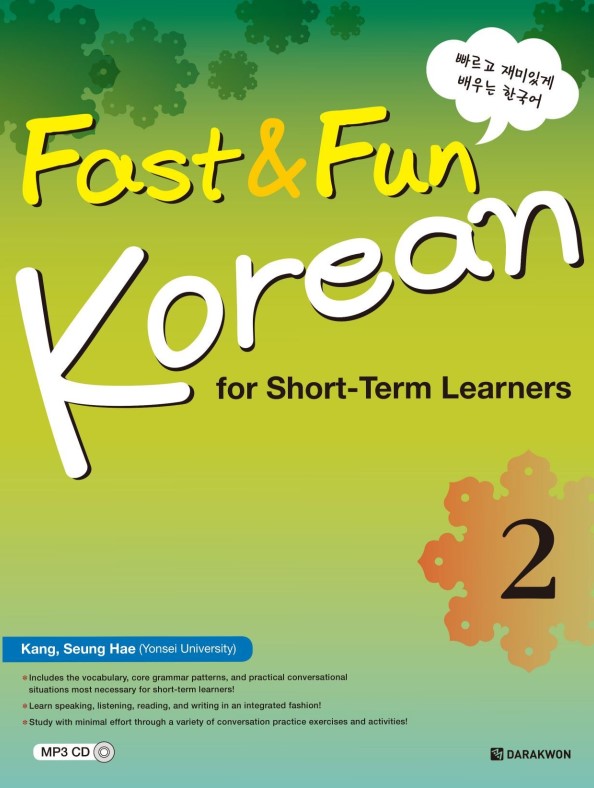
* Includes vocabulary, core grammar patterns, and practical conversation * Learn speaking, listening, reading and writing in an integrated fashion! * Study with minimal effort through a variety of conversation practice exercises and activities 머리말 Preface 이 책의 구성과 활용 How to Use This Book 차례 Table of Contents Unit 01. 안녕하세요? 만나서 반가워요. Hello! Pleased to meet you. Unit 02. 동생이 둘 있어요. I have two younger siblings. Unit 03. 기숙사가 어디에 있어요? Where is the dormitory? Unit 04. 생일이 언제예요? When is your birthday? Unit 05. 취미가 뭐예요? What is your hobby? Unit 06. 순두부하고 된장찌개 주세요. We�ll have Sundubu and Doenjang jjigae, please. Unit 07. 집에서 쉬었어요. I relaxed at home. Unit 08. 백화점 정문 앞에서 두 시에 만나요. Let�s meet at 2 o�clock in front of the Department Store. Unit 09. 2호선에서 3호선으로 갈아타야 해요. You should transfer from subway Line 2 to Line 3. Unit 10. 좀 큰 걸로 주세요. Please give me a bigger one. Unit 11. 영희 씨 계세요? Is Yeonghee there? Unit 12. 제주도에 가 봤어요? Have you been to Jeju Island? Appendix 정답 Answers 듣기 대본 Listening Scripts 핵심 문형 번역 Key Patterns Translation 색인 Index...머리말 Preface 이 책의 구성과 활용 How to Use This Book
Korean Pronunciation Guide is a learning material for the self-study of pronunciation, targeted for Level 2 to 4 learners, or beginners and intermediate learners of Korean. The pronunciation rules that have been covered in bits and pieces in existing Korean textbooks are summarized here in systematic structures and contents. Basic Korean pronunciations are presented by consonants, vowels, final consonants (Batchim) and liaisons; then rules that learners want to know the most in studying pronunciation are summarized in order, including palatalization and nasalization. After learning the basics and rules, learners can perform self-diagnosis of the accuracy and speed of pronunciation based on the colloquial and literary words categorized by difficulty and by subject. This book will help learners start the study from the pronunciation principles and eventually expand the study to improve speaking and listening skills. ▪ A systematic 3-step structure, composed of basics, rules and recitation The basics step will help learners study the fundamental Korean pronunciations starting from the principles applied in creating hangeul. The rules part will help learners study pronunciation rules applied between syllables. In the last step, learners can study the applications of these rules and practice to read texts out following the actual dialogue speed. ▪ Vivid illustrations and detailed English explanations to effectively study complicated pronunciations Illustrations are detailed and vivid, how the speech organs are moved when articulating. These will allow learners to compare and study pronunciations that they are particularly struggling with. All explanations are offered in English so that even Korean learners with less than intermediate proficiency can easily understanding the contents. ▪ 20 texts for recitation with diverse materials to learn culture and improve fluency The writing materials are closely linked to real life, and total 20 texts are offered both in colloquial and literary styles. Learners can listen and repeat after them, expanding their understanding and knowledge of Korean culture. Texts in various styles are read by professional voice actors and learners can practice and improve their fluency as they try to follow the recorded reading speed. Preface 4 How to Use This Book 6 Contents 10 An Overview of Korean Pronunciation 13 PartⅠ. BASIC KOREAN PRONUNCIATION 1 Vowels 모음 20 2 Consonants 자음 33 3 Final Consonants 받침 45 4 Liaison 연음 53 PartⅡ. PRONUNCIATION RULES 1 Aspirated Consonants: 축하 [추카] 62 2 Elimination of ㅎ Pronunciation: 괜찮아요 [괜차나요] 70 3 Fortis Articulation: 식당 [식땅] 76 4 Palatalization: 같이 [가치] 86 5 Nasalization ①: 박물관 [방물관] 92 6 Nasalization ②: 정류장 [정뉴장] 100 7 Nasalization ③: 대학로 [대항노] 106 8 Liquidization: 설날 [설랄] 112 9 Addition of ㄴ: 시청역 [시청녁] 120 PartⅢ. READING PRACTICE Preparations for Reading 130 Colloquial Speech 1 Volunteering 봉사 활동 142 2 Interview 1 Job Seeker 취업 준비생 147 3 The Host 영화 ‘괴물’ 152 4 Nami Island 남이섬 157 5 Stretching 스트레칭 163 6 Interview 2 Film Director 영화감독 169 7 Gwangjang Market 광장 시장 174 8 Interview 3 Job Interview 면접 180 9 Weather Forecast 일기 예보 186 10 Counseling 상담 191 Written Korean 11 Coffee 커피 197 12 Korean Drama 한국 드라마 203 13 Pojangmacha (Cart Bar) 포장마차 208 14 Patbingsu 팥빙수 213 15 Military 군대 219 16 Cheering for Baseball 야구 응원 문화 224 17 Chicken and Beer 치킨과 맥주 230 18 A Man Who Cooks 요리하는 남자 236 19 Ajumma Perm 아줌마 파마 242 20 Day Culture 데이 문화 248 APPENDIX Answers 256 English Translations 259 Explanations in Korean 268 Hangeul Table 276 Reading Numbers 277 Index 279
About This Book - Learning Korean is easier when you know Chinese characters! - Learn frequently used Chinese characters in Korean! - Enhance your vocabulary by using words written in Chinese characters! - This book will make it easy to read and write Chinese characters! Why this book? This book is intended for foreign students learning Korean. It was developed by the Korean Language Education Center in the Language Research Institute of Seoul National University reflecting the needs of the learners of Chinese characters. For teachers, the book shows how to teach the Chinese characters that learners often find difficult. It is composed of the most frequently used Chinese characters. The beginner level is focused on learning characters and the intermediate level on word formation. The systematic structure of the book will help learners grasp Chinese characters easily. - The Chinese characters in the textbook were chosen to expand the Korean vocabulary. - You can expand the Korean vocabulary by learning frequently used Chinese characters in Korean and the characters often used to make compound words. - This book has a systematic structure: the beginner level is to learn single characters and the intermediate level is to learn words written in Chinese characters. - You can practice the characters learned in < Today�s Characters > in context, and also see how a character is really used in a word. - Through the various exercises in < Let�s Practice > , you can practice and write the Chinese characters that acquired in each chapter.
Click here to download the audiofiles Korean Made Easy - Starter (2nd Edition) precedes Korean Made Easy for Beginners (2nd Edition), which is establishing itself as the best-selling Korean textbook for self-study and is a revised edition based on the latest trends. This is the best textbook that introduces the Korean language to beginners who want to learn the shape and pronunciations of Hangeul in the easiest way. The five-step learning method of ‘Let’s Warm-up, Let’s Study, Reading Activity, Listening Activity, Quiz Yourself’ makes learning and understanding Hangeul, pronunciation, basic vocabulary, and key expressions simple and fun. You can master Hangeul perfectly in just 20 hours, and practice pronunciation via the QR code audio file. In addition, you can learn Hangeul and basic vocabulary in a fun way through various types of practice exercises, portable expression cards, and visual learning aids. Learners can familiarize themselves with Hangeul and Korean expressions anytime, anywhere.▪ A customized Korean textbook for learners wanting to self-learn basic Korean!This is a revised version of the self-study Korean bestseller Korean Made Easy - Starter, providing customized explanations for basic Korean learners.▪ Detailed explanations of Korean characters and pronunciation are included!The basics of the Hangeul characters are explained, and similar pronunciations are presented to help beginners learn Hangeul and familiarize themselves with new characters. In addition, QR code mp3 files containing the speech of native Korean speakers enable ease of pronunciation practice.▪ Master the letter and pronunciation of Hangeul through various activities and fun exercises!Learners who are new to Hangeul and Korean can learn the pronunciation and letter system through diverse activities in a fun way by solving various game-based practice exercises.▪ Expression cards and visual learning aids enable easy learning and can be used immediately!24 essential, useful expressions are provided in cards for beginners. Basic Korean expressions can be learned anytime, anywhere through these useful expression cards. In addition, consonants, vowels, consonant-vowel combinations, and numbers visual learning aids help learners who are new to Korean become more familiar with Hangeul. Table of Contents 머리말 Peface 04일러두기 How to Use This Book 06차례 Contents 10내용 구성표 Table of Contents 12Part 1 Introduction to Hangeul 14Part 2 Characteristics of Korean Vowels and Consonants 18Part 3 Characteristics of Korean Sentences 21Chapter 1 Six Basic Vowels ㅏ ㅓ ㅗ ㅜ ㅡ ㅣ 26Chapter 2 Three Basic Consonants ㅁ ㄴ ㄹ 34Chapter 3 Six Basic Consonants ㅂ ㄷ ㅅ ㅈ ㄱ ㅎ 44Chapter 4 Final Consonants ㅁ ㄴ ㄹ ㅇ ㅂ ㄷ ㅅ ㅈ ㄱ ㅎ 56Chapter 5 Four [y] Vowels ㅑ ㅕ ㅛ ㅠ 70Chapter 6 Two Basic Vowels ㅐ ㅔ & Two [y] Vowels ㅒ ㅖ 82Chapter 7 Four Aspirated Consonants ㅍ ㅌ ㅊ ㅋ 92Chapter 8 Seven Compound Vowels ㅘ ㅝ ㅙ ㅞ ㅚ ㅟ ㅢ 108Chapter 9 Five Tensed Consonants ㅃ ㄸ ㅆ ㅉ ㄲ 122Chapter 10 Final Consonants ㅍ ㅌ ㅊ ㅋ ㅆ ㄲ & Double Final Consonants 136Final Review 150부록Ⅰ AppendixⅠ정답 Answers 154듣기 대본 Listening Scripts 162색인 Index 171부록Ⅱ AppendixⅡ24개의 중요 표현 카드 Twenty-four Useful Expression Cards 183
A fun and effective way to learn Korean vocabulary 2,500 essential must-know vocabulary words for daily life Clear explanations, memorable illustrations and practical examples Test your knowledge with exercises to imporve vocabulary retention Download MP3 files here. Korean Made Easy - Vocabulary (2nd Edition) is the vocabulary volume of the Korean Made Easy series, a bestseller in self-study Korean language books. This book allows learners to study the various meanings and usage of Korean vocabulary in a systematic and effective way, leading to fun and easy learning. It carries 100 lessons which are divided into 3 parts according to meanings and themes. Readers will learn about 2,500 Korean words ranging from beginner to intermediate level. Examples of usage of practical vocabulary words are kindly illustrated, and readers can even hear and practice speaking by using the QR code which provides audio resources. The questions at the end of each lesson provide necessary practice and drill to learn the usage of essential words. *A customized Korean vocabulary book for English speakers! As the English version of the bestselling self-study Korean language learning book, Korean Made Easy –Vocabulary (2nd Edition) provides English speakers with a customized tool for learning Korean. *100 lessons on essential vocabulary words grouped according to meanings and themes! Approximately 2,500 words ranging from beginning to intermediate levels are introduced through 100 lessons. Words are suggested in parts 1, 2, and 3, depending on the difficulty level of the example sentences so the reader may comprehend the contexts of usage effectively. *Study vocabulary and even practice speaking through helpful illustrations and audio content! Various visual images, audio content, conversational cards and varied practice questions help readers effectively learn vocabulary and even practice speaking skills for actual conversations. *Readers may select vocabulary according to themes they need! Chapters in the book gradually introduce vocabulary of higher levels, but each level is designed independently, so readers may skip and select chapters in any order they like. Contents 서문 Preface 04 일러두기 How to Use This Book 06 목차 Contents 10 Part 1 Numbers Unit 01 Reading Numbers 1 16 Unit 02 Reading Numbers 2 18 Unit 03 Reading Prices 20 Unit 04 Counting Items 22 Time Unit 05 Months and Dates 24 Unit 06 Holidays 26 Unit 07 Days of the Week 28 Unit 08 Years 30 Unit 09 Weeks and Months 32 Unit 10 Days and Years 34 Unit 11 Reading the Time 36 Unit 12 Expressing Duration 38 Personal Information Unit 13 Countries 40 Unit 14 Nationalities and Languages 42 Unit 15 Occupations 44 Unit 16 Age 46 Unit 17 Family 48 Places Unit 18 Places 1 50 Unit 19 Places 2 52 Unit 20 On the Street 54 Unit 21 Location and Direction 56 Unit 22 Asking Directions 58 Things Unit 23 Possessions 60 Unit 24 Describing Your Room 62 Unit 25 Describing Your Home 64 Unit 26 Furniture and Household Items 66 Everyday Unit 27 Daily Routine 68 Unit 28 Household Activities 70 Unit 29 Daily Activities 72 Unit 30 Housework 74 Unit 31 Weekend Activities 76 Unit 32 Common Verbs 78 Unit 33 Common Adjectives 80 Unit 34 Common Expressions 1 82 Unit 35 Common Expressions 2 84 Food and Drink Unit 36 Fruits 86 Unit 37 Vegetables 88 Unit 38 Meat and Seafood 90 Unit 39 Common Foods and Ingredients 92 Unit 40 Beverages 94 Unit 41 Snacks and Desserts 96 Unit 42 The Dining Table 98 Unit 43 Meals 100 Unit 44 Cooking Methods 102 Leisure Unit 45 Hobbies 104 Unit 46 Sports 106 Unit 47 Travel 1 108 Unit 48 Travel 2 110 Unit 49 Communication 112 Unit 50 Purchasing Goods 114 People Unit 51 Physical States and Sensations 116 Unit 52 Emotions 118 Unit 53 Describing People 120 Unit 54 Body Parts and Illnesses 122 Unit 55 Body Parts 124 Unit 56 Clothing 126 Nature Unit 57 Seasons 128 Unit 58 Weather 130 Unit 59 Animals 132 Unit 60 The Countryside 134 Part 2 Talking about Oneself Unit 61 Appearance 138 Unit 62 Personality 142 Unit 63 Feelings 146 Unit 64 Interpersonal Relationships 148 Unit 65 Life 152 Problems Unit 66 Injuries 154 Unit 67 Medical Treatment 156 Unit 68 Household Problems 158 Unit 69 Everyday Problems 160 Unit 70 Problematic Situations 162 Opposites Unit 71 Opposite Adverbs 1 166 Unit 72 Opposite Adverbs 2 168 Unit 73 Opposite Adjectives 1 170 Unit 74 Opposite Adjectives 2 172 Unit 75 Opposite Verbs 1 176 Unit 76 Opposite Verbs 2 178 Unit 77 Opposite Verbs 3 182 Other Verbs Unit 78 Movement Verbs 184 Unit 79 Body-Related Verbs 186 Unit 80 Common Verb Pairs 190 Part 3 Verbs Unit 81 The Verbs 가다 & 오다 196 Unit 82 The Verb 나다 202 Unit 83 The Verb 하다 206 Unit 84 The Verb 되다 210 Unit 85 The Verbs 생기다, 풀다, and 걸리다 214 Unit 86 Action and the Result of the Action 220 Unit 87 Money-Related Verbs 226 Unit 88 Verbs by Category 230 Expressions Unit 89 Emotion Expressions 238 Unit 90 Shopping Expressions 244 Unit 91 Clothing Expressions 248 Unit 92 Time Expressions 254 Unit 93 Quantity Expressions 260 Unit 94 Location Expressions 264 Language Unit 95 Markers 268 Unit 96 Interrogatives 276 Unit 97 Adverbs 282 Unit 98 Conjunctive Adverbs 292 Unit 99 Adjectives 296 Unit 100 Nouns 300 Appendix Answers 308 Listening Scripts 326 Vocabulary Index 340
Download MP3 Files here This book covers a total of approximately 2,000 words according to the following criteria. Selected the vocabulary words appeared more than 3 textbooks from the language institutes of nine universities and two private institutes on the basic first and second level Korean. • The words organized into fourteen topics. The provided example sentences are related to each topic focused on the example sentences used in textbooks and practical sentences frequently used in everyday life• Useful word translations in English, Chinese, and Japanese!• The antonym, synonym, honorific form, low form, related word(s), and reference word(s) are provided in order to widen the students' vocabulary.• A review test similar with TOPIK with 'Let's Check'.• Through learning the Chinese characters, learners will be able to widen their vocabulary range.• Accurately recorded entry words and example sentences available through MP3 downoad Contents 1 약속하기 Making an Appointment Let’s Check!2 인간관계 Human Relationships Let’s Check!3 직장 생활 Office Life Let’s Check!4 하루 일과 Daily Work Let’s Check!• Korean through Chinese Characters 員 a member 06 여가 생활 Leisure1 여행 Travel Let’s Check!2 운동 Exercise Let’s Check!3 음악 Music4 취미 Hobbies Let’s Check!• Korean through Chinese Characters 出 to go out 07 날씨 Weather 1 계절 Seasons2 일기예보 Weather Forecast Let’s Check!• Korean through Chinese Characters 新 to be new 08 시간 Time1 날짜 Date Let’s Check!2 시간 Time Let’s Check!• Korean through Chinese Characters 日 a day 09 패션 Fashion 1 미용 Beauty Care 2 소품 Accessories 3 의류 Clothing Let’s Check!• Korean through Chinese Characters 物 a thing 10 경제활동 Economic Activities1 가게/시장 Store/Market Let’s Check!2 경제 Economy 3 쇼핑 Shopping Let’s Check!• Korean through Chinese Characters 入 to enter 11 교통/통신 Transportation/Communication1 길 찾기 Finding the Way 2 방향 Directions Let’s Check!3 우편 Mail4 위치 Locations5 전화 Telephone Let’s Check!6 탈것 Vehicles Let’s Check!• Korean through Chinese Characters 通 to be connected 12 장소 Places1 건물 Buildings 2 길 Roads Let’s Check!3 도시 Cities 4 동네 Neighborhoods5 서울 Seoul Let’s Check!• Korean through Chinese Characters 場 a place 13 집/자연 House/Nature 1 동식물 Animals and Plants 2 자연환경 Natural Environment Let’s Check!3 전기/전자 제품 Electric/Electronic Appliances4 집안 Household 5 집안 가구/물건 Household Furniture/Goods Let’s Check!6 집안 구조 Structure of the House 7 집안일 Housework Let’s Check!• Korean through Chinese Characters 家 a house 14 문화 Culture 1 대중매체 Mass Media2 사회 Society Let’s Check!3 영화/연극 Movies/Plays4 예술/문학 Art/Literature 5 전통문화 Traditional Culture Let’s Check!• Korean through Chinese Characters 動 to move 15 기타 Etc.1 기타 Etc.• Let’s Check! 부록 Appendix추가 어휘 Additional Vocabulary • 국가명 Nations • 색깔 Colors • 운동 Sports • 가계도 Family Tree • 신체 부위 명칭 The Names of Body Parts• 착용 동사 Verbs Related to Clothing and Accessories• 띠 The Chinese Zodiac Signs • 요일 Days of the Week• 월 Months •• 숫자 Numbers • 접속부사 Conjunctive Adverbs• 준말 Abbreviations • 반의어 Antonyms• 유의어 Synonyms • 단위명사 Counting Units • 전국 지도 National Map • 서울 지도 Seoul Map 불규칙 동사 • 형용사 활용표 Table of Irregular Verbs and Adjectives정답 Answer 색인 Index
Click here to download the audiofiles The everyday life book of the bestselling Korean Made Easy series 50 common expressions for daily conversations 24 real-life conversations with illustrations Easy-to-understand grammar, vocabulary and pronunciation information Includes up-to-date practical information on living in Korea and Korean culture This book is a part of the Korean Made Easy series, a bestseller in self-study Korean language books. This volume helps beginner and intermediate students learn Korean through examples of real-life situations. Part 1 deals with 50 expressions which are very often used in everyday situations, and readers may even practice conversations skills with these expressions. Part 2 introduces 24 conversational examples visitors are likely to experience in Korea, along with vocabulary, pronunciation, grammar and cultural content that are useful in real-life situations.*Developing conversational skills by practicing real-life situations!**The book allows beginning to intermediate students (A2~B1) who have knowledge of Hangul, tense and basic elements to learn practical conversational Korean. The “grammar rehearsal” and “conversation rehearsal” parts provide practice for vocabulary and grammar, ultimately resulting in increased communication skills.*Conversations are provided in both slow pace and regular pace for enhanced listening skills!**Part 2 offers two versions of conversations; once slow and then at regular speed so students may understand the audio better. Students may also repeatedly listen to the pronunciation of native speakers using the QR code, for enhanced listening skills.*A fun way to understand the cultural background of the Korean language!**In the final part of each chapter in part 2, various information about Korean life and culture is provided in Spanish to help students better understand Korea and Koreans in general. A fun way to self-study! Contents 서문 Preface 04 이 책의 사용법 How to Use This Book 06 목차 Contents 10 내용 구성표 Table of Contents 12 등장인물 Main Characters 17 Part 1 50 Useful Expressions Unit 01 Greetings when meeting for the first time 20 Unit 02 Expressing gratitude and apology 24 Unit 03 Expressing your thoughts 28 Unit 04 Responding to others 32 Unit 05 Greetings in everyday life 36 Unit 06 Expressions at the dinner table 40 Unit 07 Congratulating, consoling, and encouraging 44 Unit 08 Talking on the telephone 48 Unit 09 Asking someone to repeat 52 Unit 10 Saying goodbye 56 Part 2 24 Scenes in Everyday Life Chapter 1 Beginning your journey in Korea Scene 01 좀 천천히 말해 주세요. Could you please speak slowly? 65 Scene 02 반대쪽에서 타세요. Take the train on the opposite side. 73 Scene 03 외국인이세요? Are you a foreigner? 81 Scene 04 이쪽으로 쭉 가면 오른쪽에 편의점이 있어요. If you go straight this way, there is a convenience store on the right. 89 Chapter 2 Preparing the necessary items for living in Korea Scene 05 외국인 등록증을 신청하고 싶어요. I want to apply for a foreigner registration card. 99 Scene 06 지금 이 집을 볼 수 있어요? Can I view this house now? 107 Scene 07 얼마 동안 돈을 내야 돼요? For how long do I have to pay? 115 Scene 08 제가 매운 음식을 못 먹어요. I can’t eat spicy food. 123 Chapter 3 Making appointments with friends in Korea Scene 09 우리 같이 영화 볼까요? Do you want to see a movie together? 133 Scene 10 내일 친구들하고 영화를 보려고 해요. I’m going to see a movie with my friends tomorrow. 141 Scene 11 사람이 많아서 유진 씨가 안 보여요. I can’t see you, Yujin, because there are too many people here. 149 Scene 12 죄송합니다. 지금 빵이 없습니다. Sorry. There is no bread right now. 157 Chapter 4 Adapting to life in Korea Scene 13 더 싼 거 있어요? Is there anything cheaper? 167 Scene 14 너무 짧지 않게 잘라 주세요. Please, cut it so that it is not too short. 175 Scene 15 토요일에 하지만 일요일에 쉽니다. We are open on Saturdays but closed on Sundays. 183 Scene 16 비행기로 보내시겠어요? Would you like to send it by plane? 191 Chapter 5 Working out problems Scene 17 열도 있고 콧물도 나요. I have a fever and a runny nose. 201 Scene 18 옷이 조금 크니까 한 치수 작은 사이즈로 주세요. The clothing is a little big, so could you give me one size smaller? 209 Scene 19 이따가 출발할 때 연락해 주세요. Please contact me when he leaves later. 217 Scene 20 가방을 잃어버렸는데 어떻게 해야 돼요? I lost my bag, what should I do? 225 Chapter 6 Traveling in Korea Scene 21 방을 예약했는데 확인해 주시겠어요? Could you please confirm the room that I reserved? 235 Scene 22 돌아오는 배가 몇 시에 있어요? What time is the return ship? 243 Scene 23 ‘바다’ 식당에 가 보세요. Go to the restaurant ‘Bada’. 251 Scene 24 한국에서 여행해 봤어요? Have you traveled in Korea? 259 부록 Appendix 문법표 Grammar Chart 268 정답 Answers 277 색인 Index 279
Click here to download the audiofiles Korean Made Easy - Intermediate (2nd Edition) is the sequel to the best-selling Korean textbook for self-study Korean Made Easy for Beginners (2nd Edition). This book is carefully designed and structured for intermediate Korean learners to easily and enjoyably learn vocabulary, expressions, and grammar. The textbook is divided into 15 topics and each respective topic is presented in 3 situations based on practical grammar and vocabulary. These vocabulary and expressions are also covered in the additional vocabulary corner and the Sino-Korean character learning corner. In addition, grammar explanations and grammar usage tables necessary for intermediate learners are included in detail in the appendix, and translations of new vocabulary and expressions from the conversations are provided. This book is an ideal, comprehensive intermediate Korean self-study textbook.▪ This best-selling, self-study integrated textbook contains practical grammar and vocabulary necessary for intermediate Korean learners!The sequel to the best-selling Korean textbook for self-study, ‘Korean Made Easy for Beginners (2nd Edition)’. Grammar and vocabulary are carefully selected and presented based on the topic in each conversation so that learners can acquire practical usage.▪ Detailed grammar explanations with vivid and diverse visuals, and natural English translations!Illustrations vividly express the situations and expressions, making it easy to understand conversational situations and the context in which vocabulary is used. Detailed, natural English translations simplify intermediate Korean grammar, which can oftentimes be complicated.▪ Visual aids improve Sino-Korean vocabulary retention!Intermediate learners can easily grasp the meaning of Sino-Korean vocabulary, improve their understanding, and expand their learning by visualizing Sino-Korean characters while studying Korean with English translations.▪ Effective learning aids with a variety of exercises and activities!The grammar and vocabulary covered throughout the textbook can be practiced immediately through a variety of exercises and activities. Thereby, enhancing learning and retention. Table of Contents 서문 Preface 04일러두기 How to Use This Book 06목차 Contents 11교재구성표 Table of Contents 12등장인물 소개 Main Characters 16Chapter 01 첫 만남 Meeting Someone for the First Time 17Chapter 02 일상생활 Everyday Life 33Chapter 03 약속 Appointments 49Chapter 04 길 찾기 Asking Directions 65Chapter 05 음식 Food 81Chapter 06 공공 규칙 Public Rules 97Chapter 07 집 In the House 113Chapter 08 쇼핑 Shopping 129Chapter 09 한국 생활 Living in Korea 145Chapter 10 문제 Problems 161Chapter 11 사람 People 177Chapter 12 건강 Health 193Chapter 13 관심사 Interests 209Chapter 14 여행 Travel 225Chapter 15 관계 Relationships 241부록 Appendix 257문법 부록 Grammar Appendix 258한국어 활용 Korean Conjugation 291문법 활용표 Conjugation Charts 296정답 Answers 312한자어 색인 Word Web Appendix with Hanja 316색인 New Vocabulary & New Expressions 322
Koreanisch Lernen mit Koreanischen TV-Serien For intermediate Learners! Click here to see sample pages Learn Korean while watching K-drama scenes on YouTube and Netflix!Inside the book: scripts, YouTube links, and Netflix timestamps to five sensational Korean drama shows● Learn Korean through scripts and clips from five of the latest and hottest K-drama shows.● Feel the joy of deepening your understanding of the Korean language through detailed explanations and exercises on dictation, vocabulary, and sentence structures.● Internalize everyday Korean language including colloquial expressions, popular neologisms used amongst today’s younger generation, shortened words, text abbreviations, and slang.● Casually encounter Korean food, fashion, entertainment, and cultural values through the K-drama content.Publisher’s Review A Korean Language Textbook Centered on K-Drama Scripts and VideosLearn Korean through K-Dramas 3 is a Korean language textbook developed around short scenes from five of the most popular Hallyu K-drama shows, making the study of the Korean language fun and effective. This third book of the K-Drama Korean Series features K-drama shows of varying genres: Another Miss Oh, Something in the Rain, Strong Girl Bong-soon, Hospital Playlist (Season 1), and Vincenzo.While studying the Korean language through the included drama scripts, readers will not only be able to peek at how Koreans define love and deal with separation but also gain a deeper understanding of various issues in Korean society, including those concerning equality, work ethics, and social justice.This book is unique in that each script comes with a QR code and a Netflix timestamp that provide direct links to corresponding YouTube videos and Netflix scenes, allowing for readers to access the clips at any time and understand the language content while watching and listening to it on screen. This third book also features illustrations that capture the mood of each drama show to allow a more intuitive and immersive learning experience.This book is also written entirely in both English and Korean to enable even beginner Korean language students to make the most out of its content. The right-side pages of the book are dedicated to the original K-drama scripts and the left-side pages provide English translations for a convenient learning experience for students of all proficiency levels. The Korean scripts come with Romanized pronunciation guides so that readers can easily acquaint themselves to accurate pronunciations. The book is optimal for self-study, and its size (150 x 200 mm), relatively small for a textbook, makes it handy and portable.Moreover, the book’s various exercises requiring short, subjective answers as well as the proven-effective dictation practice sections make the book suitable not only for self-study but also as a workbook for use in schools and academies. In particular, this second book places further emphasis on grammar to aid students preparing for the Test of Proficiency in Korean (TOPIK). Furthermore, the cultural commentary in the book helps readers encounter and understand Korea’s food, fashion, entertainment, and cultural values in connection to the K-drama scenes.Understanding Various Expressions Used on K-Drama Shows and Learning Colloquial Korean, Acronyms, and SlangThough the videos are each only about five minutes long, there is a lot to be learned from their content. Vocabulary and grammar are thoroughly explained with examples from the scripts, and exercise questions to help readers master the various expressions used in the scenes are included in each lesson.K-drama shows mirror Korean language as it is used every day—colloquial expressions, popular or newly-coined terms and slang used by young people, text abbreviations, idioms, and so on—which greatly benefits those who want to learn “real-life” Korean language.About the Series The first book in the series Learn Korean through K-Dramas featured romantic K-drama shows that won popularity both at home and abroad: You Who Came from the Stars, Descendants of the Sun, Goblin (Dokkaebi), Hotel Del Luna, and Crash Landing on You.The second book featured shows that offer an intensive look into various social issues in Korea: It’s Okay Not to Be Okay, Itaewon Class, My Mister, SKY Castle, and Misaeng: Incomplete Life.Sequels in the series will continue to be published to help students stay on course with their studies while learning the Korean language in a fun and easy way.About the AuthorWith a bachelor’s degree in Korean language education and a doctorate in Korean language and literature from Seoul National University, Lee Miok has delivered lectures on Korean language and culture at numerous schools including Hanyang University, Dankook University, Kookmin University, and Kangnam University for the past 10 years. She currently serves as a senior researcher at the Institute of Humanities at Seoul National University (SNUIH) and a visiting professor at Myongji University.
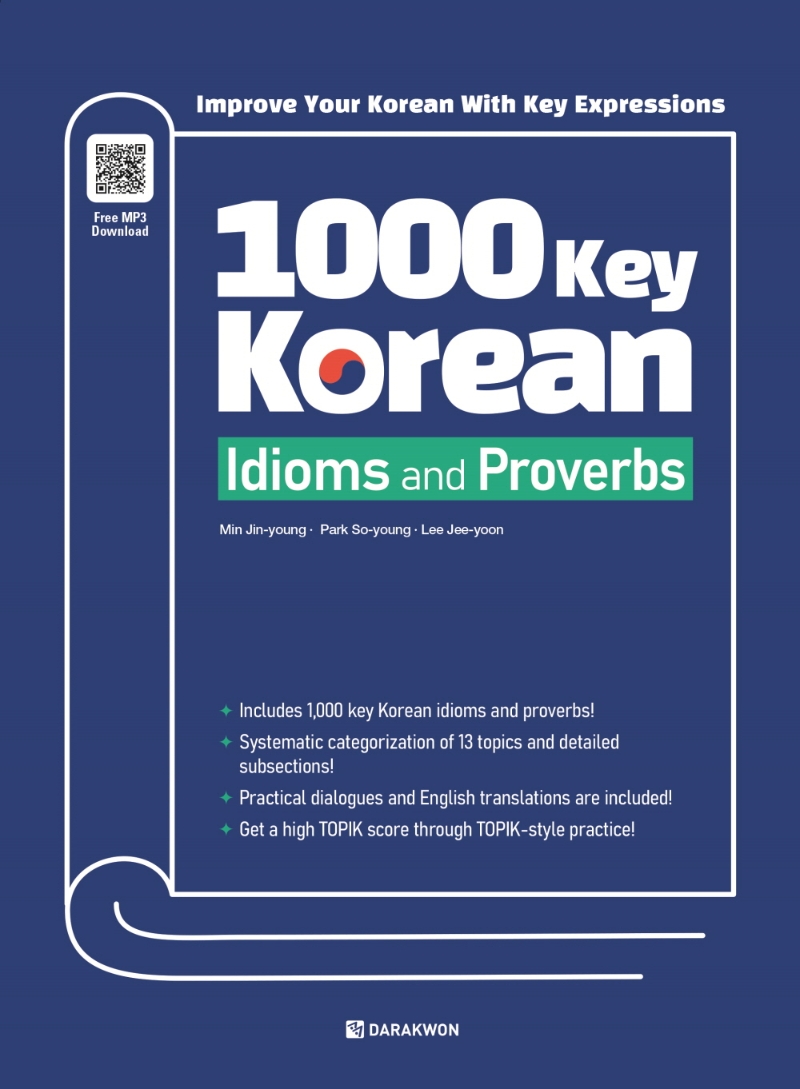
Download Free Audio Files here This book was designed to present Korean idioms and proverbs in the form of a dictionary to enable foreign students learning Korean to use these expressions in everyday conversation. Idioms and proverbs also appear as important expressions in TOPIK questions, and they are highly useful in everyday life. In this book, 1,000 idioms and proverbs that were selected according to frequency have been divided into 13 major themes and sub-topics to be studied. Vivid example sentences utilizing each expression are presented in a conversational format, and English translations and audio recordings are also provided to enhance students’ understanding. Using “Confirmation Questions” and “Idioms and Proverbs Seen in TOPIK Questions” in the appendix, students can check their level of understanding and identify how idioms and proverbs are mainly used in TOPIK reading questions, so this book can also be highly useful for preparing for the TOPIK exam. ▪ 1,000 carefully selected key Korean idioms and proverbs! This book contains a total of 1,000 entries that include expressions with high frequency of use and great educational effectiveness based on five major sources. Both Korean and English translations explaining the meaning of each entry are included, and synonyms, origins, and additional explanations are also provided to increase students’ understanding of each expression. ▪ Study by subject using 13 systematically categorized major themes and sub-topics! 1,000 expressions were categorized and sorted into 13 major themes, and the major themes were then divided into a total of 56 sub-topics so students could efficiently learn the expressions by grouping them by subject. Confirmation questions are provided in the appendix so students can check that they have mastered the expressions in each sub-topic and so they can review and self-evaluate. ▪ English translations and audio files of practical dialogues provided! Sample dialogues utilizing each expression are provided along with English translations so students can understand how each expression is used in actual conversations in context. In addition, audio files recorded by professional voice actors are provided through QR codes so students can master the correct pronunciation and intonation all at once. ▪ Obtain a high score on the TOPIK exam through TOPIK-style practice questions in the appendix! Using TOPIK-style practice questions in the appendix, students can check how the idioms and proverbs they have learned are presented in TOPIK reading questions. After studying the major themes, students can solve TOPIK-style questions to review the content they have learned while also completing adequate practice to achieve a high score on the TOPIK exam. Contents 머리말 Preface 004 이 책의 구성 및 활용 How to use this book 006 목차 Table of Contents 010 1장 감정·정신 Emotions and Senses 1 감동·감탄 Being Moved and Admiration 014 2 걱정·고민 Worries and Troubles 018 3 고통 Pain 025 4 관심 Interest 031 5 불만·분노 Dissatisfaction and Anger 039 6 불안·초조 Anxiety and Nervousness 046 7 안도 Relief 053 8 욕심·실망 Greed and Disappointment 059 9 정신 상태 State of Mind 064 2장 소문·평판 Rumors and Reputation 1 간섭·참견 Interference and Meddling 070 2 긍정적 평판 Positive Reputation 078 3 부정적 평판 Negative Reputation 082 3장 태도 Attitude 1 겸손·거만 Humility and Arrogance 092 2 선택 Choices 096 3 의지 Will 103 4장 행동 Actions 1 대책 Countermeasures 112 2 반응 Reactions 117 3 방해 Obstructions 123 4 소극적 행동 Passive Behavior 127 5 적극적 행동 Active Behavior 133 5장 언어 Language 1 과장 Exaggeration 142 2 말버릇 Way of Speaking 148 3 행위 Action 154 6장 조언·훈계 Advice and Discipline 1 권고·충고 Recommendations and Advice 164 2 조롱 Ridicule 173 3 핀잔 Scolding 178 7장 일·생활 Work and Lifestyle 1 사회생활 Social Life 186 2 속성 Attributes 191 3 실행 Implementation 198 4 의식주 Life Necessities 206 5 종결 Termination 213 8장 경제 활동 Economic Activity 1 손익·소비 Profit & Loss and Consumption 220 2 형편 Circumstances 226 9장 관계 Relationships 1 갈등·대립 Conflict and Opposition 234 2 대우 Treatment 243 3 사교·친교 Social Interactions and Friendships 249 4 사랑·정 Love and Affection 256 5 소통·협력 Communication and Cooperation 262 10장 상황·상태 Situations and Conditions 1 결과 Results 268 2 곤란 Hardships 273 3 문제·문제 해결 Problems and Problem Solving 280 4 분위기·여건 Atmosphere and Conditions 284 5 시간·거리 Time and Distance 293 6 흥미 Excitement 297 11장 판단 Judgment 1 변별 Discrimination 304 2 신체 기관 Bodily Organs 311 3 외모·외형 Appearance and Looks 317 4 인지·인식 Perception and Awareness 323 12장 인생 Life 1 성공 Success 334 2 습관·경험 Habits and Experience 339 3 실패 Failure 350 4 운·기회 Luck and Opportunity 356 5 일생 Lifetime 365 13장 이치 Logic 1 인과 Cause and Effect 372 2 자연 Nature 378 3 진리 Truth 385 〈부록 Appendix〉 문화 이야기 Culture Story 394 확인해 봅시다 Let’s Check 407 TOPIK 속 관용 표현과 속담 Idioms and Proverbs in TOPIK 447 정답 Answer 460 색인 Index 465
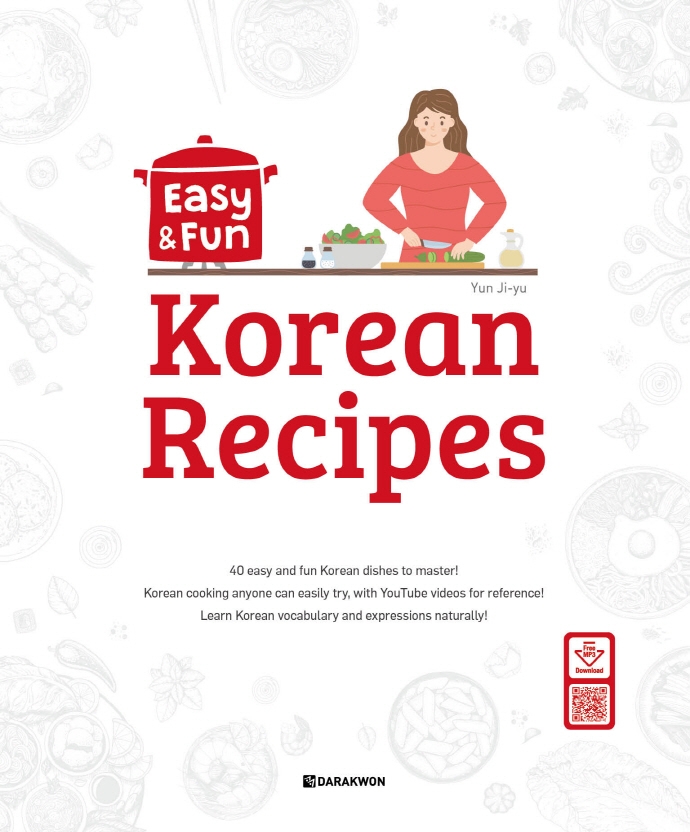
Easy and Fun Korean Recipes is a textbook that teaches Korean through cooking, created when the author considered how to make Korean learning more entertaining. It specially includes YouTube videos of the author personally cooking, to which readers can refer along with the textbook in order to make it easier to try cooking the 40 Korean dishes within. Dishes and snacks frequently eaten by Korean people are organized by 6 different ingredients (kimchi, rice, eggs/tofu, meat, seafood, etc.), and while learning how to cook Korean food, readers can also learn vocabulary related to simple ingredients and expressions, and even practice conversation. In addition, not only can readers instantly connect and refer to videos of each recipe via QR code, they can even hear each cooking terms and conversation sentences recorded by professional voice actors, provided via QR code as well. Download Audiofiles here Visit author's recipes on YouTubeIncludes 40 easy and fun recipes for Korean dishes that anyone can follow along withA textbook with 40 carefully selected Korean dishes organized by 6 main ingredients so that even foreigners can easily follow along and choose a dish to try cooking for themselves.Introduction of ingredients and the cooking process are provided together in Korean and English for easier understanding.Check the author’s cooking videos on YouTube via QR code for quick and easy understandingEach recipe includes a QR code so readers can instantly connect and refer to the author’s cooking videos on YouTube to understand the cooking process at a glance and follow along.Using videos that include step-by-step explanations of everything from the ingredients to the cooking process, readers can try cooking Korean dishes without difficulty.A Korean textbook you can use to study Korean cooking alongside Korean vocabulary and expressionsEach recipe includes relevant vocabulary for ingredients and cooking expressions, with simple explanations and example sentences, and readers can even learn Korean grammar.All vocabulary words and example sentences can be checked instantly by connecting via QR code to recordings from professional voice actors. Contents 김치볶음밥 Kimchi-bokkeumbap 김치전 Kimchijeon 김치찜 Kimchijjim 배추김치 Baechukimchi 2. 쌀 Rice떡꼬치 Tteok-kkochi 떡볶이 Tteokbokki 궁중떡볶이 Gungjungtteokbokki 비빔밥 Bibimbap 김밥 Gimbap 3. 달걀 · 두부 Eggs · Tofu달걀말이 Dalgyalmari 계란찜 Gyeranjjim 두부부침 Dububuchim 두부김치 Dubukimchi 순두부찌개 Sundubujjigae 4. 고기 Meat불고기 Bulgogi 갈비탕 Galbitang 갈비구이 Galbigui 갈비찜 Galbijjim 장조림 Jangjorim 소고기뭇국 Sogogi-mutguk 고추장불고기 Gochujangbulgogi 동그랑땡 Donggeurangttaeng 삼계탕 Samgyetang찜닭 Jjimdak 닭갈비 Dakgalbi 5. 해산물 Seafood해물파전 Haemulpajeon 미역국 Miyeokguk 새우전 Saeujeon 어묵탕 Eomuktang 오징어볶음 Ojingeo-bokkeum 6. 기타 Other된장찌개 Doenjangjjigae 부대찌개 Budaejjigae 잡채 Japchae 김말이 Gimmari 호떡 Hotteok 감자전 Gamjajeon 호박죽 Hobakjuk 핫도그 Hot dog 짜파구리 Jjapaguri AppendixExplantions in Korean Index